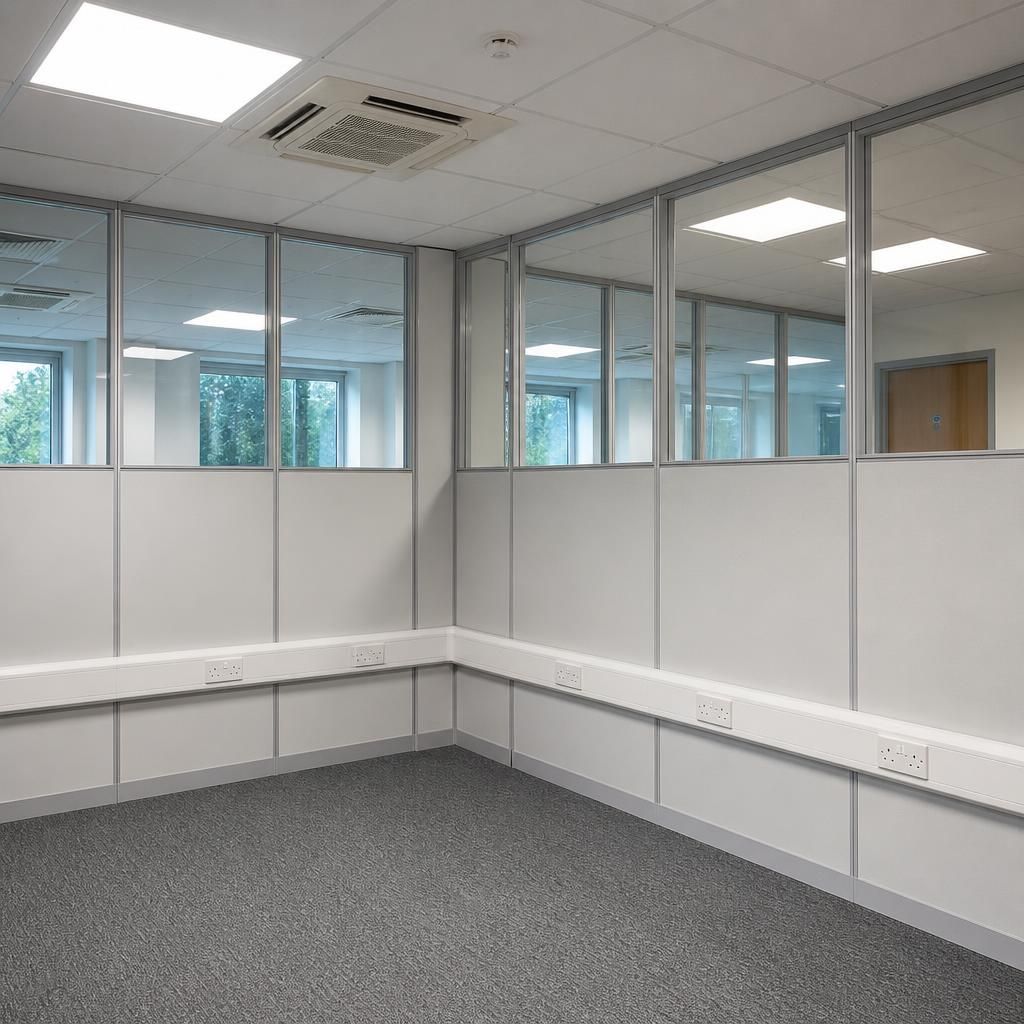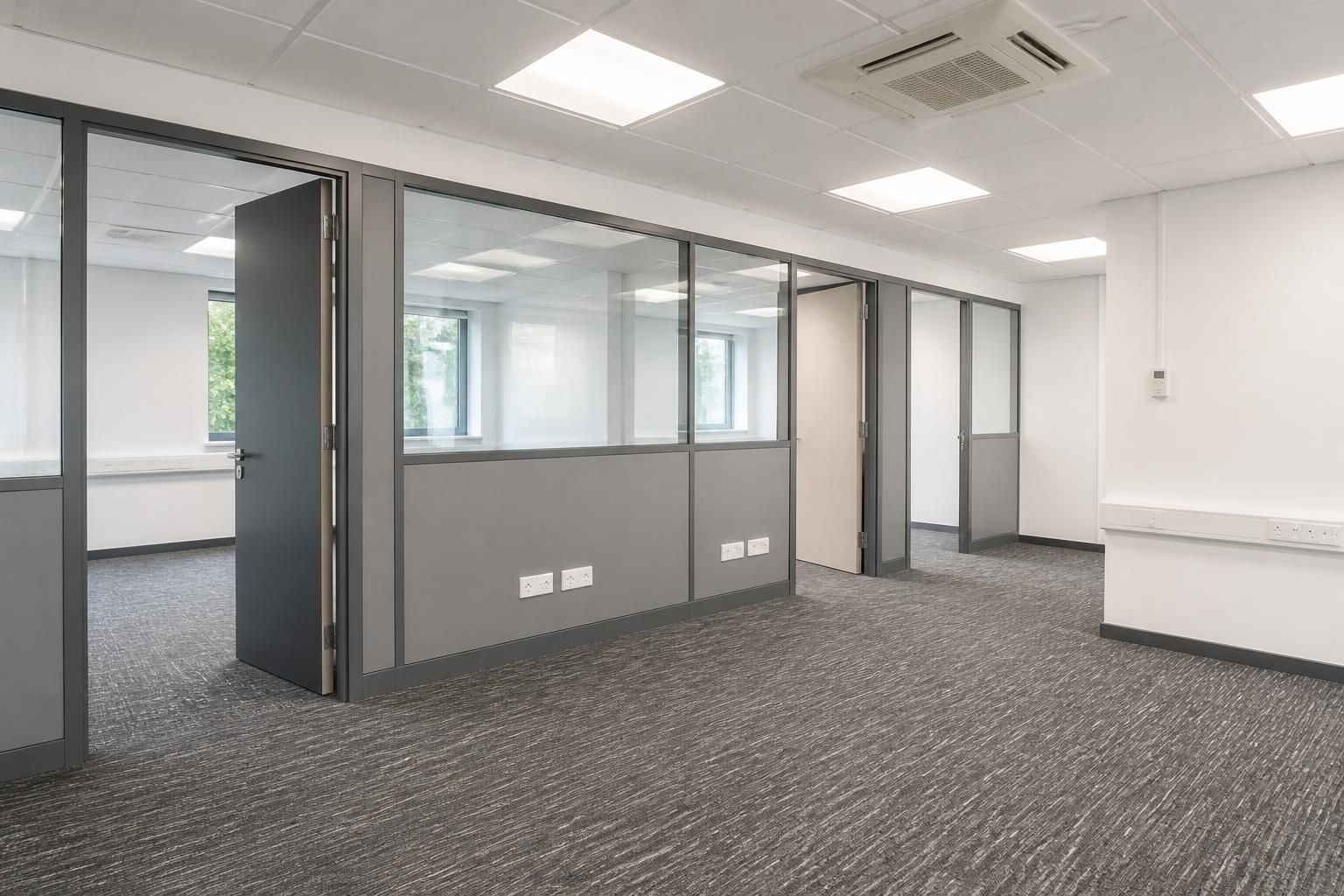
Can office partitioning systems fit around existing office services?
Office partitioning systems can fit around existing office services when the layout is assessed before installation. We use a site meeting and survey, followed by written proposals and working drawings, to coordinate partitioning with services, access and workspace requirements.
Existing office services do not automatically prevent office partitioning systems from fitting the space. The partition layout can be developed around fixed service routes, access points and connection requirements.
The main consideration is how each service relates to the proposed partition line. Power outlets, data points, lighting, ventilation and other building services may sit within walls, ceilings or floor zones. The design must account for their positions before materials are ordered and installation begins.
- Services that can remain in place: The partition line may avoid outlets, service routes and equipment where moving them offers no benefit.
- Services that need access: Access panels or planned openings can preserve access to relevant points after the partition is installed.
- Services affected by the new layout: The drawings can identify areas where a service connection, outlet or fitting may require adjustment.
- Services passing through the new partition: The route and required opening can be considered before installation, rather than being discovered during the work.
This approach matters because a partition can change how people reach sockets, controls, equipment and shared office facilities. It can also affect the position of doors, workstations and circulation routes. Keeping those relationships clear supports a practical office layout.
Existing services may place limits on the available partition positions. For example, a dense service zone, fixed equipment or restricted ceiling area may make one layout less suitable than another. In that situation, we can compare the available positions through the written proposal and working drawings.
The drawings should make the interfaces clear. They can show partition lines, doors, room divisions and known service points together. This gives you a basis for checking access, workspace use and any work needed by other contractors.
Partitioning does not necessarily require every existing service to be moved. Avoiding unnecessary alterations can reduce the work involved, although the appropriate approach depends on the site conditions and the requirements recorded during planning. Where changes are needed, the scope can distinguish partition installation from related service work.
Services also need consideration at junctions with ceilings, floors and existing walls. These points can affect the finished division between rooms and the route used for installation. Reviewing them before work starts helps identify practical constraints, including areas where access must remain available.
For offices likely to change again, the proposal can consider future access and internal reconfiguration. A partition arrangement that leaves key service points reachable may give you more options when room use or workstation positions change.
Spartan Direct brings partitioning into the wider office fit-out discussion where required. We can coordinate the proposal, drawings, installation and project management for projects involving several related workplace requirements, while identifying where other contractors may be needed for site work.
The right choice is therefore not simply the partition system that fills the planned line. It is the arrangement that respects existing services, preserves necessary access and supports the way you use the office.
Office partitioning systems need to account for services that are not visible at first inspection. Ceiling voids, floor zones and existing walls may conceal routes that affect the proposed layout.
Share available service records and identify areas that cannot be opened or disturbed. During the site survey, we can record known constraints and flag points requiring confirmation before the drawings are finalised. This gives you a clearer basis for deciding whether to retain, adjust or investigate a service before partition installation.