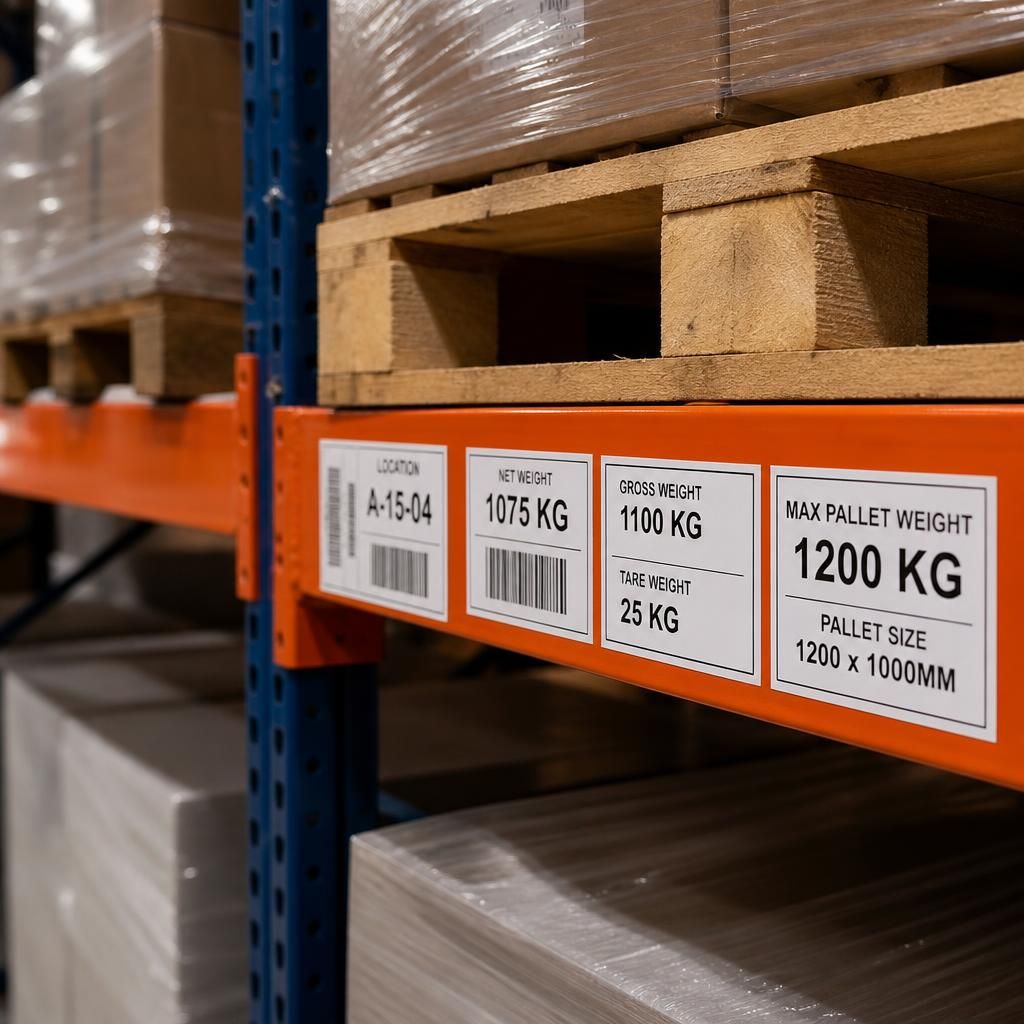
What load information should you provide for heavy duty pallet racking?
Provide maximum pallet weight, pallet dimensions, load distribution, pallet type and the number of pallets stored at each level. Include handling equipment, storage height and any changes expected, so we can assess capacity, access and layout for heavy duty pallet racking.
Accurate heavy duty pallet racking design depends on how loads behave in storage, not only their headline weight. We need enough information to assess the worst realistic loading condition.
Describe the load cases the warehouse will create. For example, explain whether adjacent bays may hold the heaviest units simultaneously, or whether different goods will share beam levels. A rack specification based on average usage may not reflect the maximum combined load.
- Load concentration: state whether goods place weight evenly across a pallet or create concentrated loading at particular points.
- Centre of gravity: identify loads that are top-heavy, offset, liquid-filled or otherwise likely to shift their centre of gravity.
- Load stability: explain how goods are secured and whether packaging can deform, settle or move during handling.
- Pallet condition: note damaged, repaired or inconsistent pallets that could affect support and placement.
- Overhang and clearance: record any load projecting beyond the pallet footprint, since this affects beam interaction and aisle access.
- Handling behaviour: explain how operators place and remove loads, including any contact, impact or sliding during positioning.
These details help distinguish a uniformly distributed load from a point load. They also show where decking, pallet supports or another storage arrangement may be needed. The suitable specification depends on the complete load case and the rack configuration.
Record the assumptions behind the load information. The specified capacity may rely on particular beam spans, upright positions, level spacing, pallet support and loading methods. Altering those conditions can change the capacity, even when stored goods remain unchanged.
It is also useful to separate confirmed information from provisional estimates. Mark loads that may change as the operation develops, and identify stock that needs a different arrangement. This gives the design process a clear basis for reviewing storage positions and future operating conditions.
During a no-obligation consultation, we can discuss these factors during site meetings and surveys. We then prepare written proposals and working drawings showing how the storage arrangement relates to the building, handling activity and stated loads.
For projects requiring coordination, project management may extend from proposal and tender stage through installation and final commissioning. Providing clear load assumptions at the outset helps keep the design, installation and later use aligned.
Support stated pallet loads with clear source information, rather than relying on informal estimates. Product specifications, weighing records and pallet data can show how each figure was established.
- Identify whether each figure is measured or estimated.
- Record the date and source of the information.
- Separate product weight from packaging and pallet weight.
- Mark figures that apply only to specific stock lines.
During a no-obligation consultation, we can review this information against the proposed storage arrangement. Clear records help keep the working drawings aligned with the loads the rack will hold.