What forklift requirements apply to drive-in pallet racking?
Forklift requirements for drive-in pallet racking depend on the truck’s dimensions, turning space, lift height, fork length, load capacity and the racking layout. We assess these factors alongside stock and site requirements, so the truck can enter the lanes safely without compromising access or storage capacity.
The correct forklift must suit the drive-in racking’s lane entrance, rail arrangement, load characteristics and operating method. A truck that fits the warehouse may still be unsuitable if its rated capacity, mast movement or fork position does not match the system.
Truck type and access
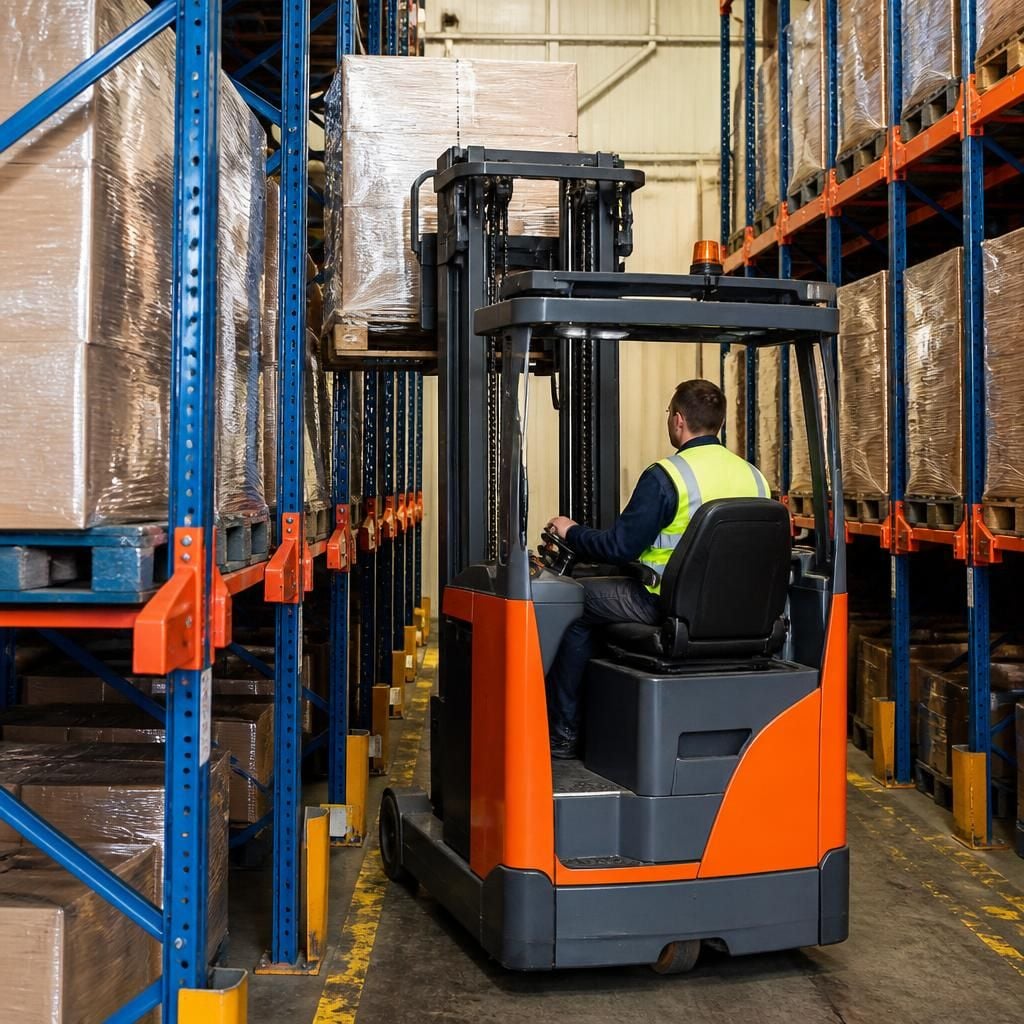
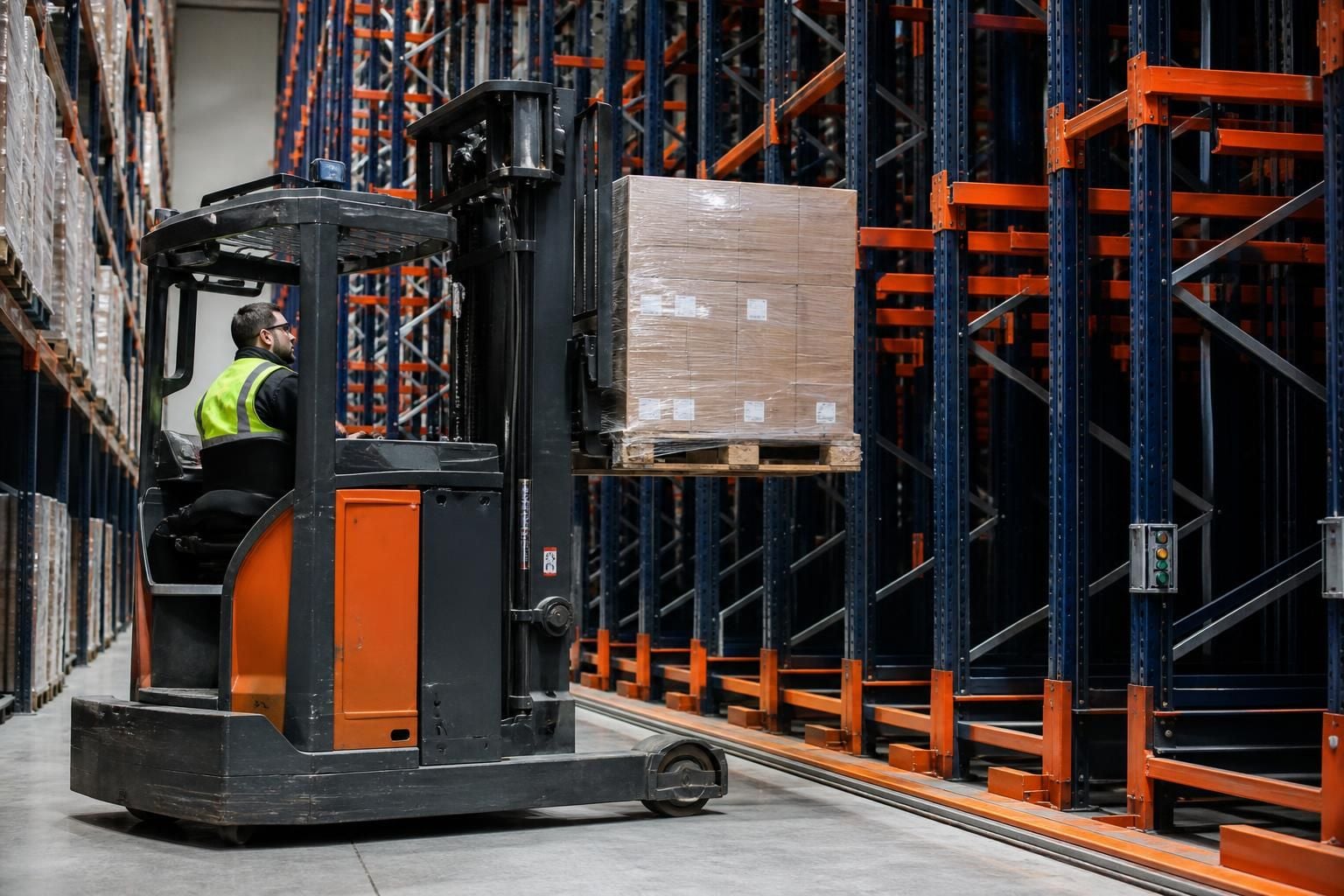
Drive-in racking requires the forklift to enter the storage lane with the load raised safely. The truck must align squarely with the lane before placing or retrieving a pallet.
Counterbalance trucks are often considered because they can carry pallets directly into the lanes. However, the truck’s body, mast and overhead guard still need suitable clearance.
Reach trucks and other specialist trucks may not suit every drive-in layout. Their mast movement, reach mechanism or operating position can conflict with the lane structure.
Truck selection therefore follows the actual racking arrangement. It should not rely on the truck type alone.
Capacity at the required lift height
Forklift capacity reduces as the load centre moves forward or the forks lift higher. Check the truck’s capacity rating at the height and load centre required for the installation.
The rating must cover the complete pallet load, not only the average product weight. Include the pallet, packaging and any unevenly distributed goods.
Loads with a high centre of gravity need particular care. Their position can affect truck stability during entry, placement and removal.
Never treat a forklift’s headline capacity as permission to handle every load. The manufacturer’s capacity plate and operating instructions provide the relevant limits.
Fork dimensions and pallet support
Forks must support the pallet correctly without contacting the racking rails, uprights or other components. Fork length, thickness and spacing all affect this clearance.
The pallet must also suit the rail positions. Damaged pallets, unsuitable pallet designs or loads extending beyond the pallet can increase contact risks.
Forks should enter fully enough to support the load while allowing the operator to keep the truck aligned. Excessive fork length can create problems inside a confined lane.
We need the pallet dimensions, load weights and handling method before confirming working clearances.
Mast, overhead and turning clearances
The forklift mast and overhead guard must pass below the available clearances at the lane entrance. Check the truck in its operating configuration, including the raised load.
The warehouse also needs enough approach space for the truck to line up with each lane. A narrow approach can cause repeated steering corrections and contact with the frame.
Consider the truck’s overall length, width, turning circle and rear swing. The rear of a counterbalance truck can move significantly during a turn.
These clearances must work with columns, doors, lighting, sprinklers, walls and other warehouse equipment. The usable space is more than the clear opening into the racking.
Floor and operating conditions
The floor should provide a suitable, level surface for the forklift and the racking. Uneven surfaces can affect stability, clearance and pallet placement.
Check floor loading, joints, slopes and changes in level around the installation. The truck’s weight combines with the load during operation.
Lighting should allow the operator to see the lane, pallet position and racking components clearly. Visibility can become more difficult when the load obstructs the forward view.
Where forward visibility is restricted, the operating method may require controlled reversing or assistance. The site’s risk assessment should define the safe procedure.
Safe use inside the lanes
Operators should enter lanes slowly and keep the truck aligned with the rails. Turning inside a storage lane can damage the racking and destabilise the load.
Place pallets without forcing them against the back stop or adjacent loads. Remove pallets with the same care, keeping the forks and load level where the method requires.
Do not use racking components to guide, stop or support the forklift. Impacts can distort frames, rails and protection equipment.
Keep pedestrians away from forklift operating areas through the site’s segregation arrangements. Marked routes, barriers and working procedures should reflect the actual traffic pattern.
Operators must follow the truck instructions, the racking instructions and the site’s risk controls. Anyone using the equipment should have suitable instruction for that operation.
Information needed before selecting the truck
- Forklift type, overall dimensions and turning information.
- Rated capacity at the required lift height and load centre.
- Mast height, lowered height and overhead guard dimensions.
- Fork length, width, thickness and adjustment range.
- Pallet length, width, condition and construction.
- Maximum load weight, load shape and centre of gravity.
- Required storage height and the number of pallets per lane.
- Approach routes, floor conditions, doors, columns and obstructions.
- Pedestrian movement and the proposed loading and retrieval sequence.
A forklift data sheet or manufacturer specification can support the assessment. Do not rely on a verbal truck description when clearances are close.
How we assess the match
Our consultation may include a site meeting and survey to understand the truck, pallets, building and working method together. We then use the information in written proposals and working drawings.
Those drawings can show lane positions, approach clearances, protection measures and the intended loading arrangement. This gives you a practical basis for checking the proposed forklift and racking combination.
Where a project requires it, we can coordinate work from proposal and tender stage through installation and final commissioning. The correct arrangement should be agreed before equipment reaches site.
If the existing forklift cannot meet the requirements, the answer may involve changing the truck, revising the lane arrangement or reviewing the pallet specification. A survey identifies which constraint affects the available storage method.
Recheck forklift suitability when equipment changes. A replacement truck may have different dimensions, capacity or mast movement, even when it performs the same task.
Before using it in drive-in pallet racking, compare its specifications with the agreed layout and pallet loads. This prevents an equipment change from creating new access or handling risks.