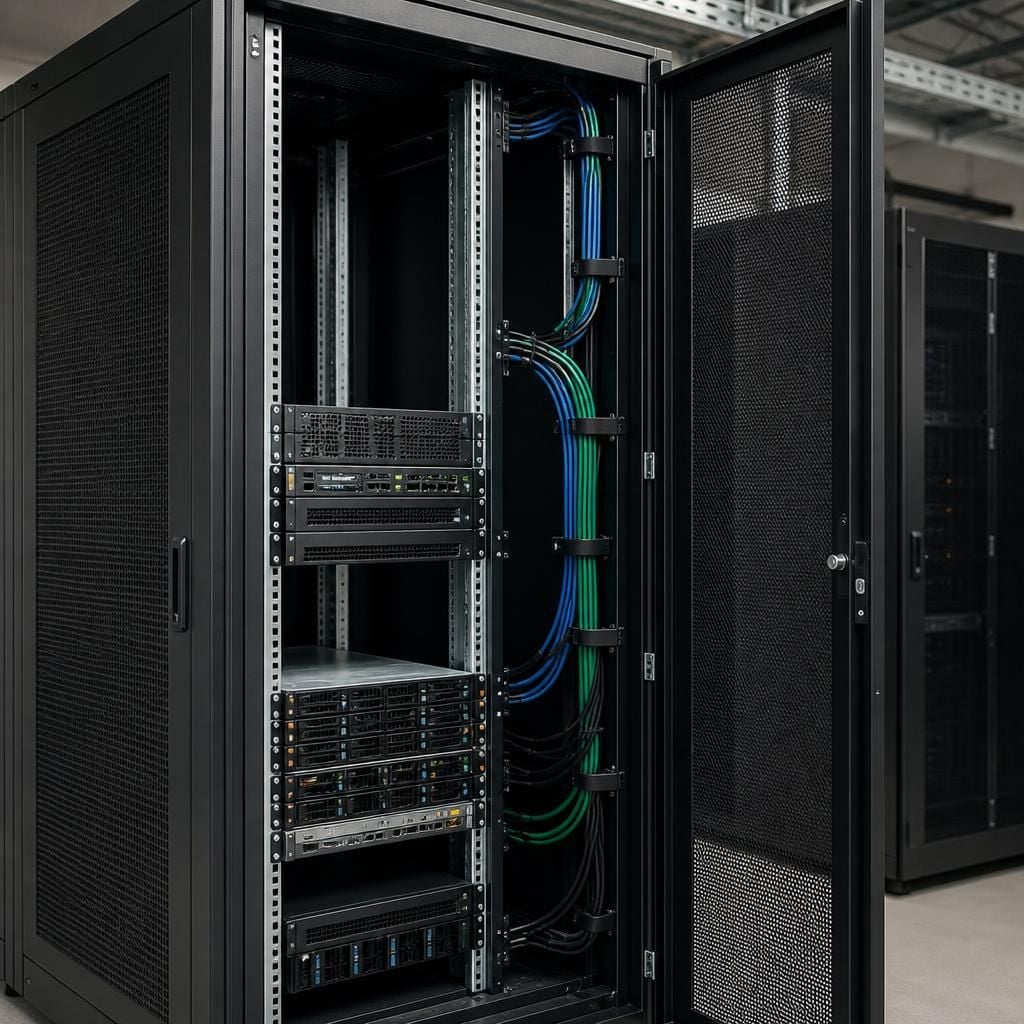
What cabinet depth does your server equipment require?
Choose cabinet depth by measuring the deepest server equipment, then allowing room for rails, cabling, airflow and safe access. Check the equipment requirements before selecting a server rack cabinet, so doors and connections remain usable without obstructing the surrounding layout.
Use the cabinet’s usable mounting depth, not its external depth. The usable figure must accommodate the complete installed equipment assembly, including rails, brackets, power connections and rear cable routing.
Cabinet dimensions can be described in different ways. External depth includes the doors, frame and panels, while usable mounting depth refers to the space available between the front and rear mounting positions. Always compare the equipment manufacturer’s requirements with the cabinet’s internal specification.
Check the complete equipment assembly. A server chassis may be shorter than its rail kit. Sliding rails can extend behind the chassis, while brackets or cable-management arms may add further depth. Measure the equipment as it will sit in the cabinet, rather than relying on the chassis measurement alone.
- Record the depth of each server, switch, patch panel or other rack-mounted item.
- Include front and rear brackets, rails, handles and cable-management parts.
- Check the required rear space for power leads, network cables and connector access.
- Confirm that the cabinet’s mounting posts can accept the selected rail system.
- Compare the full requirement with the cabinet’s stated usable mounting depth.
Allow for rear connections. A cabinet can appear deep enough for the equipment while leaving too little room behind it. Tight cable bends can obstruct connections and make later inspection or replacement more difficult. Check the bend requirements for copper, fibre and power cables before choosing the cabinet.
Also consider how equipment will be accessed after installation. Rear service access may depend on the cabinet position, removable panels and available clearance behind it. If the cabinet sits close to a wall or another unit, confirm that technicians can reach the relevant connections without moving surrounding equipment.
Do not use external depth as a substitute for a layout check. Doors, handles, plinths and cable routes can affect the space needed around the cabinet. Measure the installation area as well as the equipment, including the route for delivery and the final position within the room.
Different equipment combinations may need different depths. A cabinet for shallow network equipment may not suit a deeper server with sliding rails. A mixed installation should be checked against the deepest complete assembly, while also confirming that every item can mount securely.
Where the equipment list is still changing, record the planned additions before selecting cabinet dimensions. This helps you compare current requirements with the space needed for the intended layout, without selecting a cabinet based only on the first item being installed.
A site survey can clarify these measurements where access, room layout or equipment details are uncertain. Our consultation may include a site meeting and survey, followed by written proposals and working drawings. These documents can show cabinet position, access space and the relationship between equipment and surrounding workplace areas.
For a project involving several workplace requirements, we can coordinate the proposal, drawings, installation and project management where required. The practical aim is a cabinet depth that supports the installed equipment without obstructing servicing, connections or the surrounding layout.
Check how the cabinet’s usable depth is measured between its front and rear mounting posts. A quoted figure may not describe the space available after the posts are positioned for the equipment.
Confirm the adjustment range and mounting arrangement before ordering. This helps ensure the selected depth supports the equipment without forcing rails, connections or cable routes into an unsuitable position.