


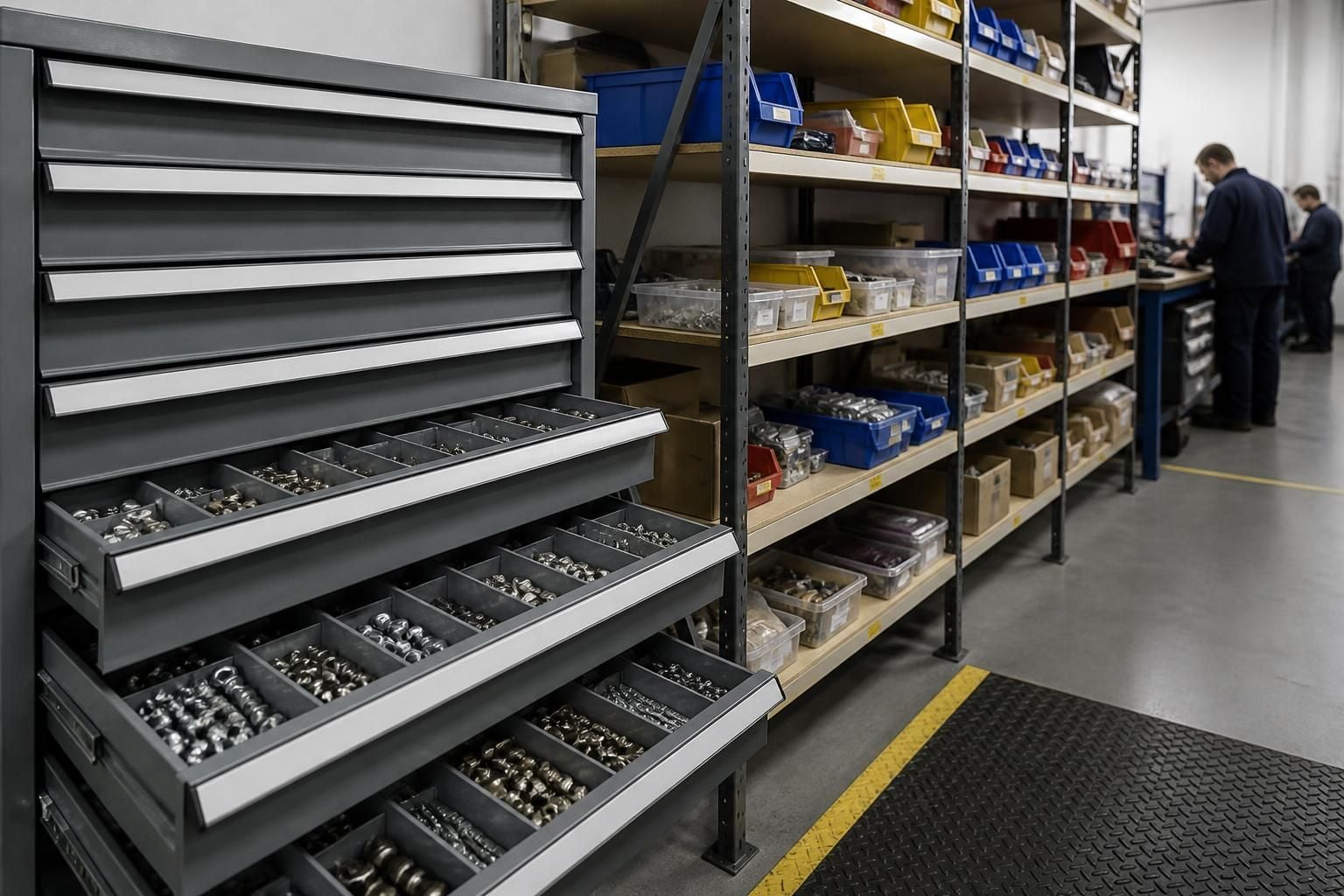
When should you choose industrial drawer cabinets over open shelving?
Choose industrial drawer cabinets when small parts need organised storage, controlled access and protection from workplace disturbance. Choose open shelving when you need immediate visibility and easy access to frequently handled stock.
Choose industrial drawer cabinets over open shelving when your stock consists mainly of small, numerous components that need a defined storage location. They suit stores, workshops and production areas where consistent identification matters more than displaying larger items across an open shelf.
Assess the stock before choosing the furniture.
- Industrial drawer cabinets suit fixings, electrical parts, engineering components, tools and other small items.
- Open shelving suits cartons, containers, irregular items and stock that does not fit neatly into drawer compartments.
- Long, bulky or frequently changing items may need shelving, cantilever racking or another storage arrangement.
- Mixed stock often benefits from cabinets for small parts, with shelving for larger items nearby.
This distinction prevents wasted capacity. Small components can occupy disproportionate shelf space when stored in loose boxes. Drawers divide that space into defined compartments, helping you use the cabinet’s internal height and width more deliberately.
Consider how staff identify and replenish each item.
Drawer cabinets allow each compartment to receive a label, stock description or part reference. That arrangement supports repeatable put-away and picking routines. It can also make shortages easier to spot during stock checks.
Open shelving gives a broader view of several containers at once. That can suit items picked often or checked visually during routine work. However, loose boxes may become mixed, misplaced or difficult to distinguish when similar parts share a shelf.
Think about the task at the storage point, rather than the furniture alone. If staff need one small component at a time, a labelled drawer may present the item more clearly. If they move several boxes together, open shelving may provide the more practical handover point.
Check the available footprint and operating clearance.
Cabinet selection must include the space needed to open and use drawers safely. A drawer extends towards the aisle, so measure the working area in front of the cabinet. Do not judge suitability from the cabinet footprint alone.
Open shelving also needs aisle and handling space. Its fixed shelves may suit a longer uninterrupted run, while cabinets may create a more compact arrangement for smaller components. The better choice depends on the building layout, access route and handling method.
Review floor condition, access routes and the proposed position before ordering. A site survey can identify obstructions, uneven surfaces and clearance issues that a room plan may miss.
Match the cabinet specification to the loads.
Do not assume that every drawer suits every component. Confirm the expected weight, dimensions and distribution of the stored items. Check the supplier’s stated capacity for the complete cabinet and each drawer.
Heavier parts may require a different cabinet specification from light consumables. The arrangement should also allow staff to handle items without overloading individual drawers or creating awkward lifting movements.
Open shelving needs the same disciplined assessment. Shelf levels, bay dimensions and load requirements must reflect the stock placed on them. A written proposal and working drawings can show the intended arrangement before installation.
Use cabinets when separation supports production or stores control.
Separate drawers can keep similar components apart by size, material, job or stage of use. This may suit engineering stores, maintenance areas and production support spaces. It also gives you a clear basis for naming storage locations.
Open shelving remains useful where stock needs flexible placement across larger shelf levels. It may be preferable for packaging, containers or items whose dimensions change regularly. Avoid forcing irregular stock into compartments that restrict handling.
Plan for cleaning, damage and the working environment.
Drawers enclose stored items more than open shelves do, which may help limit exposure to workplace disturbance. The degree of protection depends on the cabinet design and the surrounding conditions.
Consider dust, swarf, moisture, impact risk and cleaning methods before selecting either option. Some workplaces may need closed storage for particular parts, while others need open access for inspection or drying. Specify these conditions during the survey.
Allow for future stock changes without losing the original logic.
List the parts you expect to store now, then identify likely changes in size, quantity and usage. A cabinet layout that suits today’s stock may become restrictive if every drawer has a fixed purpose.
Ask how compartments, labels and stock locations can be reviewed later. Open shelving may adapt more easily to varied item sizes, while cabinets may maintain better separation for a stable small-parts range. A combined layout can accommodate both patterns.
Use a consultation when the choice affects several work areas.
We can review your stock, workflow and available space through a no-obligation consultation. This may include a site meeting and survey, followed by written proposals and working drawings.
Where the project includes shelving, pallet racking, mezzanine floors, partitioning or safety barriers, coordinated planning can help maintain clear movement between storage and working areas. Project management may also cover proposal and tender stages through installation and final commissioning where required.
The practical decision is usually clear after comparing item dimensions, loads, picking frequency, handling space and future changes. Choose industrial drawer cabinets for defined small-part storage. Choose open shelving for larger, irregular or frequently repositioned items. Use both where your stock profile demands different forms of access.
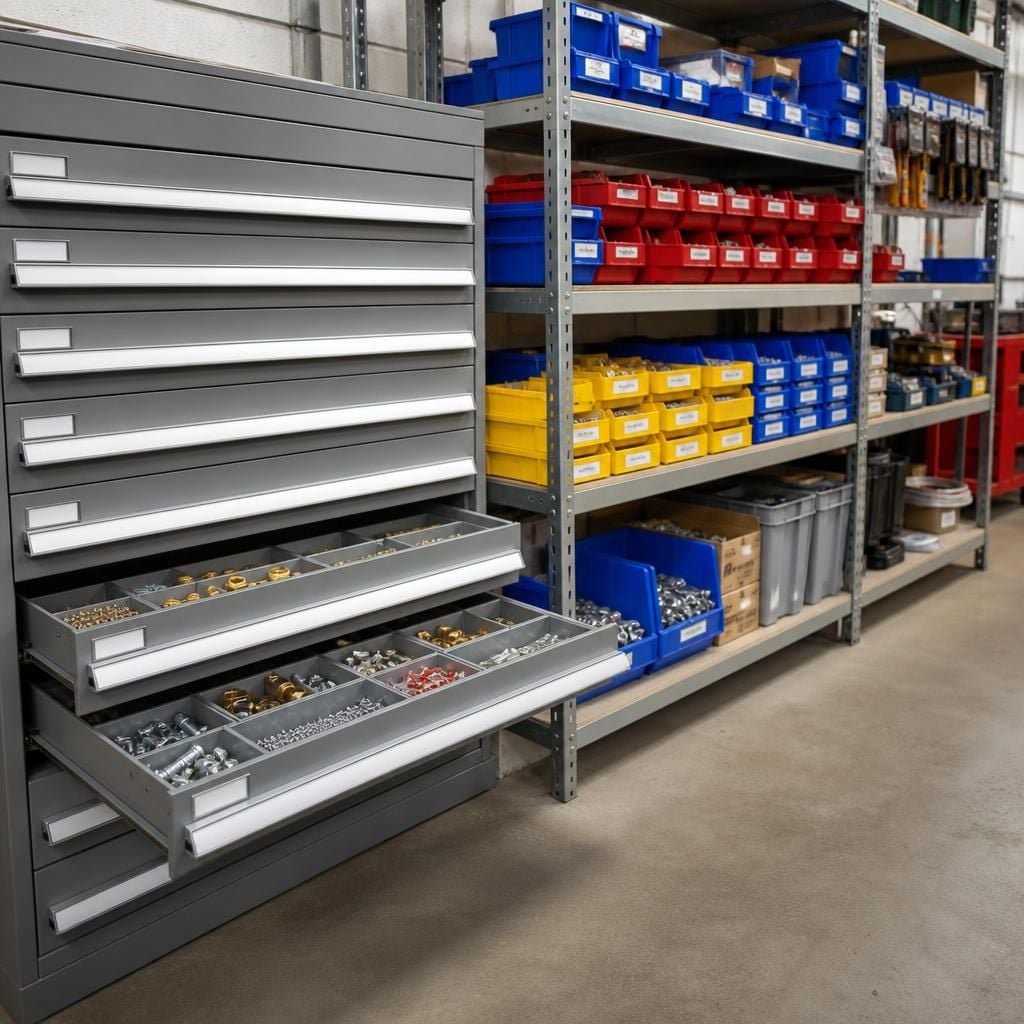
Industrial drawer cabinets can suit components that need controlled access within a shared stores or production area. Confirm the cabinet specification supports the level of restriction required, then define access responsibilities clearly.
Open shelving may remain appropriate for shared consumables and routinely handled stock. The right choice depends on whether open availability or controlled issue matters more for each item.



