


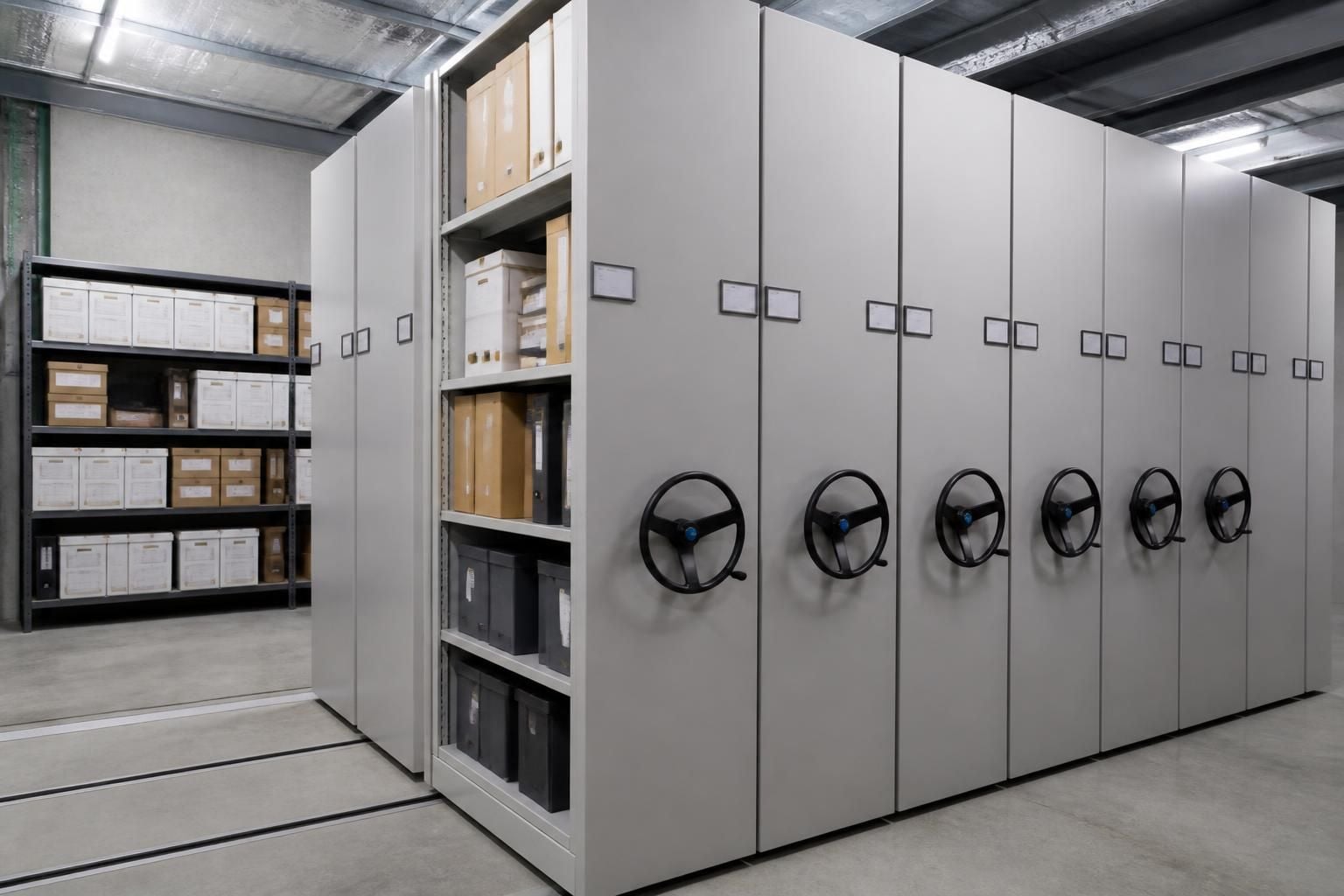
When is mobile industrial shelving suitable for a workplace?
Mobile industrial shelving suits workplaces needing more storage in limited floor area while retaining controlled access to frequently handled stock.
A site survey can assess floor conditions, loads, clearances and workflow before we prepare proposals and working drawings.
Mobile industrial shelving suits a workplace when you need concentrated storage, orderly access and fewer permanent aisles. It works best where stock is handled regularly, but not continuously from every location.
The system places shelving on movable bases, allowing selected aisles to open when access is needed. Closing unused aisles creates a more compact arrangement than separate fixed shelving rows. This can suit warehouses, workshops, archives, stores and back-of-house commercial areas with many shelving bays.
Choose mobile shelving when access can be managed. It is a practical option for stock that needs regular retrieval, but does not require simultaneous access by several people. One open aisle may serve several sections, provided the workflow allows staff to retrieve items in sequence.
- Use it for boxed components, packaged goods, tools, records or other organised small and medium-sized items.
- Consider it where stock is divided into clear categories and staff can follow a consistent location system.
- Assess it where reducing unused aisle space matters more than having every shelving row open at once.
- Include it in comparisons where fixed shelving would leave too much circulation space between bays.
It may be unsuitable when immediate access is essential. A busy picking operation may need several open aisles at the same time. In that situation, fixed industrial shelving or pallet racking may support movement more naturally.
Mobile shelving can also be a poor fit where stock changes constantly, locations lack discipline or several teams need unrestricted access. Frequent repositioning could interrupt work if the layout does not reflect actual handling patterns.
Compare the access pattern, not just the storage capacity. Ask how often each section is used, who needs access and whether retrieval happens singly or in parallel. Record replenishment routes, picking paths, trolley movements and any nearby work areas.
Consider the space required to open an aisle safely. The layout must also account for doors, columns, escape routes, equipment movement and areas where people work. A compact arrangement should not create awkward crossings or obstruct essential routes.
Load and shelving details still matter. Different items may require different shelf levels, clearances and load capacities. Heavy components should remain within a practical handling height, while frequently used items should not be placed where access becomes inconvenient.
Review the stock profile before selecting mobile shelving. If products vary in size, adjustable shelving may accommodate change more effectively. If loads are long, unusually heavy or palletised, another storage arrangement may be more suitable.
Mobile shelving can support better separation between stock groups when each bay has a defined purpose. Labels, location references and consistent filing or picking rules help staff use the available access efficiently.
Safety must shape the layout from the beginning. Moving bases, open aisles and adjacent work areas require clear operating rules. Staff should understand when an aisle can be opened, how access is controlled and which routes must remain clear.
The surrounding workplace also influences suitability. Office stores may prioritise quiet, orderly access, while industrial areas may need stronger protection against contact with handling equipment. Workplace segregation, line marking and barrier protection may form part of a wider storage layout where activities overlap.
For larger premises, mobile shelving may need to sit alongside pallet racking, fixed shelving or specialist storage. The right comparison depends on the stock, handling method and available footprint, rather than on one system alone.
We can review these factors through a no-obligation consultation, including site meetings and surveys where appropriate. We then prepare written proposals and working drawings, so you can compare the arrangement against access and operational requirements.
Where a project involves several workplace changes, project management may cover proposal and tender stages through installation and final commissioning. That provides a coordinated route when storage must work alongside other layout changes.
Mobile industrial shelving is therefore most suitable when you value compact organisation and can control access to shared aisles. It is less suitable when every shelving row needs constant, simultaneous access.
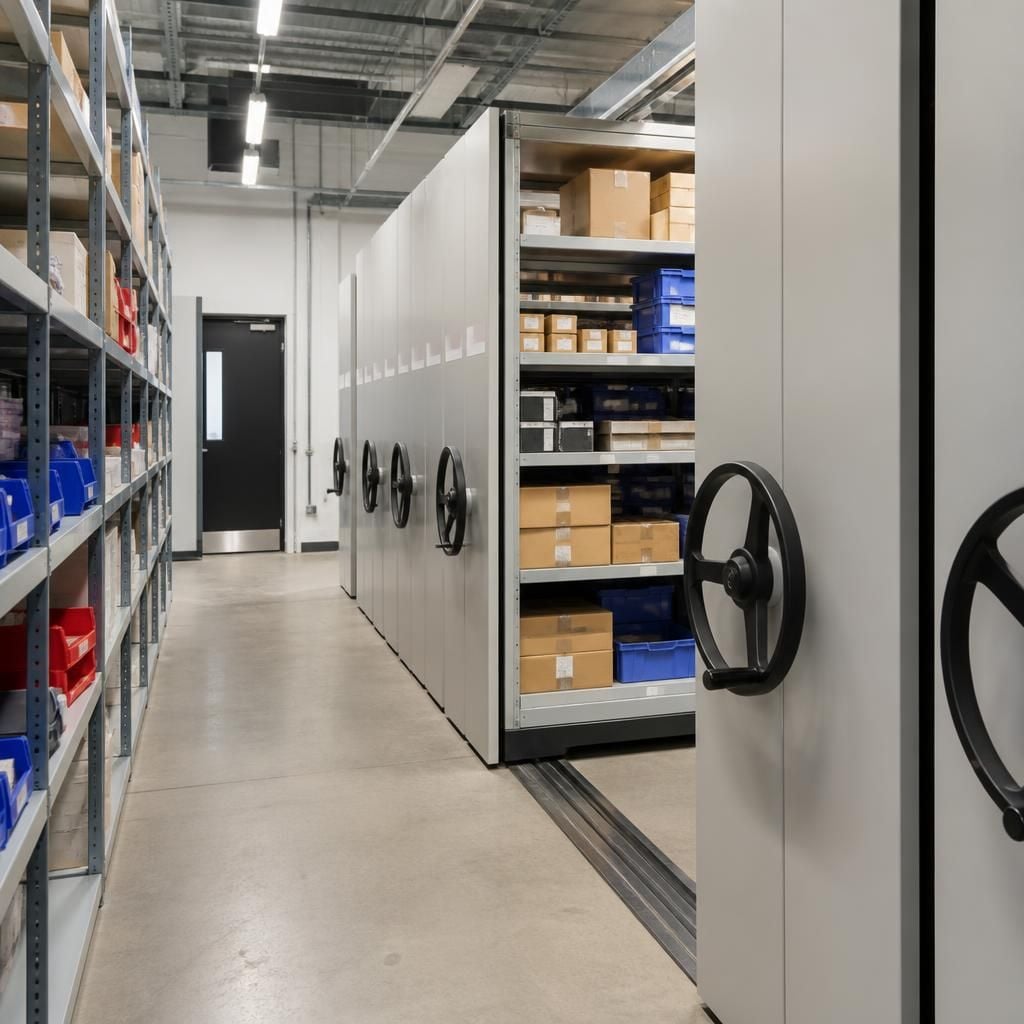
A mixed storage layout can make mobile industrial shelving suitable when one stock group needs immediate access and another needs compact storage.
Keep fast-moving items on fixed shelving near the picking route. Place slower-moving records, components or reserve stock on mobile bases, where opening an aisle when needed remains practical.
This separates daily movement from occasional retrieval instead of forcing one shelving type to serve every task. Review replenishment, picking and pedestrian routes together before setting the split.



