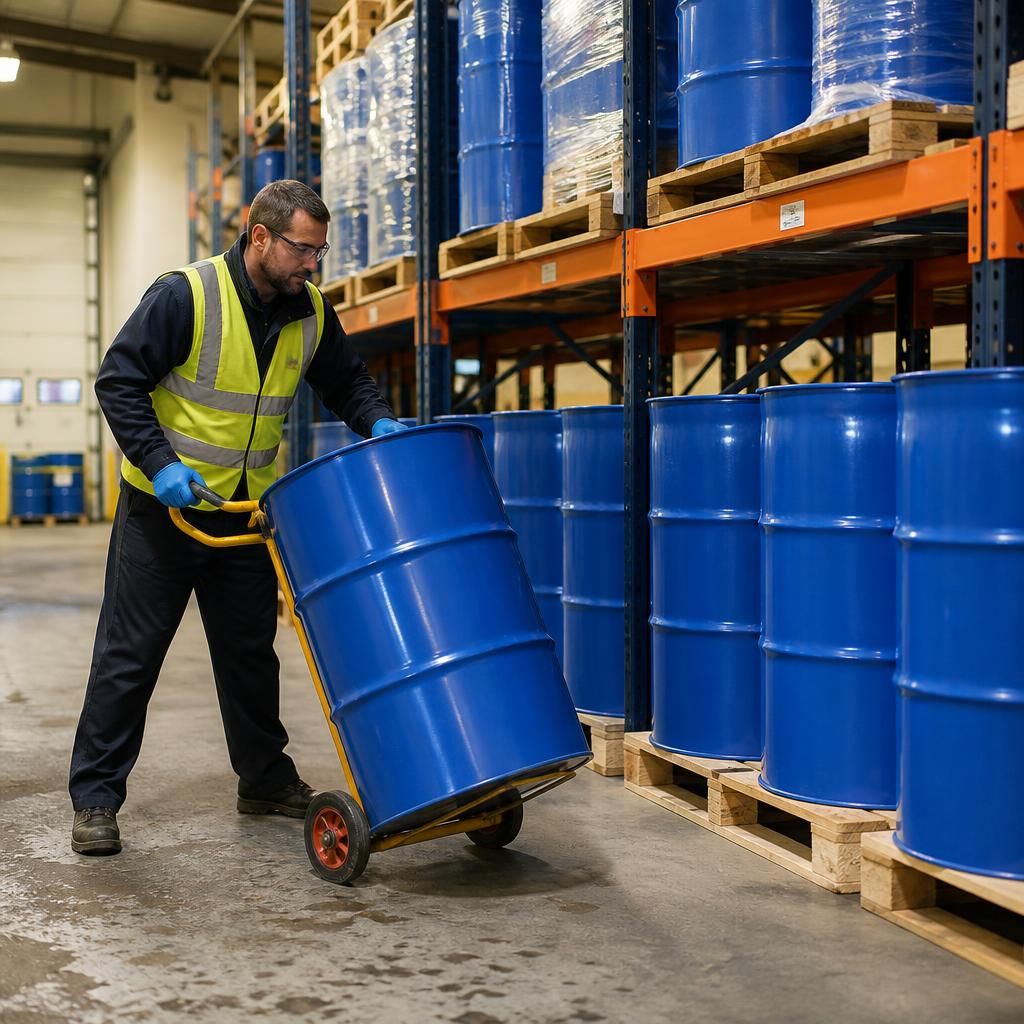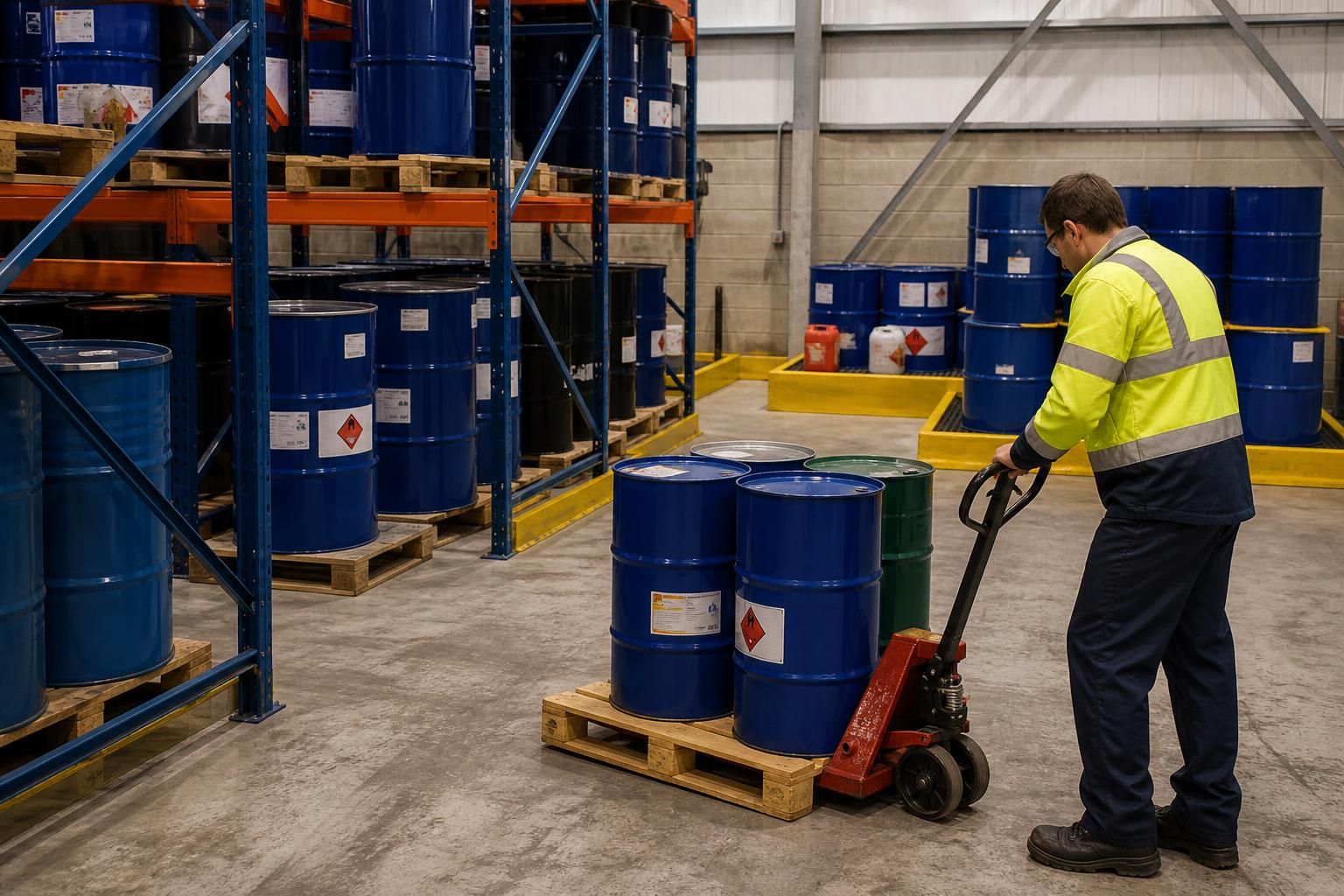
How should chemical drum storage support controlled drum handling?
Chemical drum storage should keep drums stable, identifiable and accessible, with clear handling routes that reduce unnecessary movement. We can assess the site, stock and handling requirements before preparing a storage proposal and working drawings.
Chemical drum storage should be planned around every handling stage, from receipt and putaway to picking, opening and removal. The arrangement should give operators a clear sequence, suitable handling equipment and defined controls for each movement.
Start by recording how drums arrive and how they leave storage. Consider delivery pallets, drum quantities, container sizes, filled and empty stock, and the equipment used for movement. A drum trolley, forklift attachment or pallet truck may require different clearances and access points.
- Receiving: provide space to check labels, containers and delivery information before drums enter their assigned locations.
- Putaway: position storage locations so operators can place drums without twisting, reaching across obstructions or carrying them unnecessarily.
- Picking: identify locations clearly and keep the required drum accessible without moving unrelated stock.
- Opening or decanting: keep these activities separate from ordinary storage where the process creates additional spill, vapour or ignition concerns.
- Removal: maintain a defined route from the storage position to the next work area, dispatch point or waste-handling location.
Drum storage must also suit the way containers are handled. Floor-level positions may support direct access for drum equipment, while raised positions can require compatible pallets, lifting equipment and protection against dropped loads. The correct arrangement depends on drum weight, dimensions, stability and the available handling method.
Do not treat every drum as interchangeable. Storage records should distinguish chemical type, container size, handling status and any segregation requirement. Clear location references can reduce searching and help operators select the intended container.
Separate full, part-used, empty, damaged and quarantined drums where the process requires it. This prevents an operator from selecting the wrong container or returning a suspect drum to normal stock. Damaged containers should have a defined holding arrangement and escalation process.
Drum handling also depends on usable space around the storage system. Allow room for equipment to approach squarely, position the drum and withdraw without striking adjacent containers. Protect corners, uprights and exposed edges where vehicle movement could cause contact.
Routes should remain distinct from pedestrian circulation wherever the operation creates a conflict. Marking can identify storage boundaries, travel paths and no-standing areas. Safety barriers may also protect storage from vehicle impact where the site layout calls for physical separation.
The working height matters when operators inspect, connect, open or transfer drums. Place frequently handled containers where the process allows controlled access without unnecessary lifting. Less frequently handled stock may suit different positions, provided retrieval remains controlled.
Capacity planning should include more than the drum footprint. Account for pallets, handling attachments, containment arrangements, access clearances and any separation between incompatible materials. A system that fits the containers but blocks the handling equipment does not support controlled movement.
Written procedures should match the physical arrangement. They can identify who may move drums, which equipment is permitted, where containers belong and what happens after damage or a spill. Labels and location signs should remain visible from the approach used by operators.
For changing operations, use an arrangement that can be reviewed when drum sizes, quantities or handling equipment change. Adding stock without checking clearances can obstruct routes and alter the way operators approach the storage positions.
We can examine the proposed handling sequence alongside the storage requirement, then prepare written proposals and working drawings. Where required, project management can continue through installation and final commissioning.
Spartan Direct has worked on storage systems since 1982, including projects for companies of different sizes across the UK. That experience supports practical decisions about access, separation and movement within the available premises.
Controlled drum handling continues at the transfer point. Set down drums on a stable surface, keep hands clear of pinch points and avoid rolling containers through shared routes.
Handling procedures should identify the permitted lifting attachment, securing method and set-down position for each drum type. This gives operators a consistent method when transferring containers between storage, production and dispatch areas.