


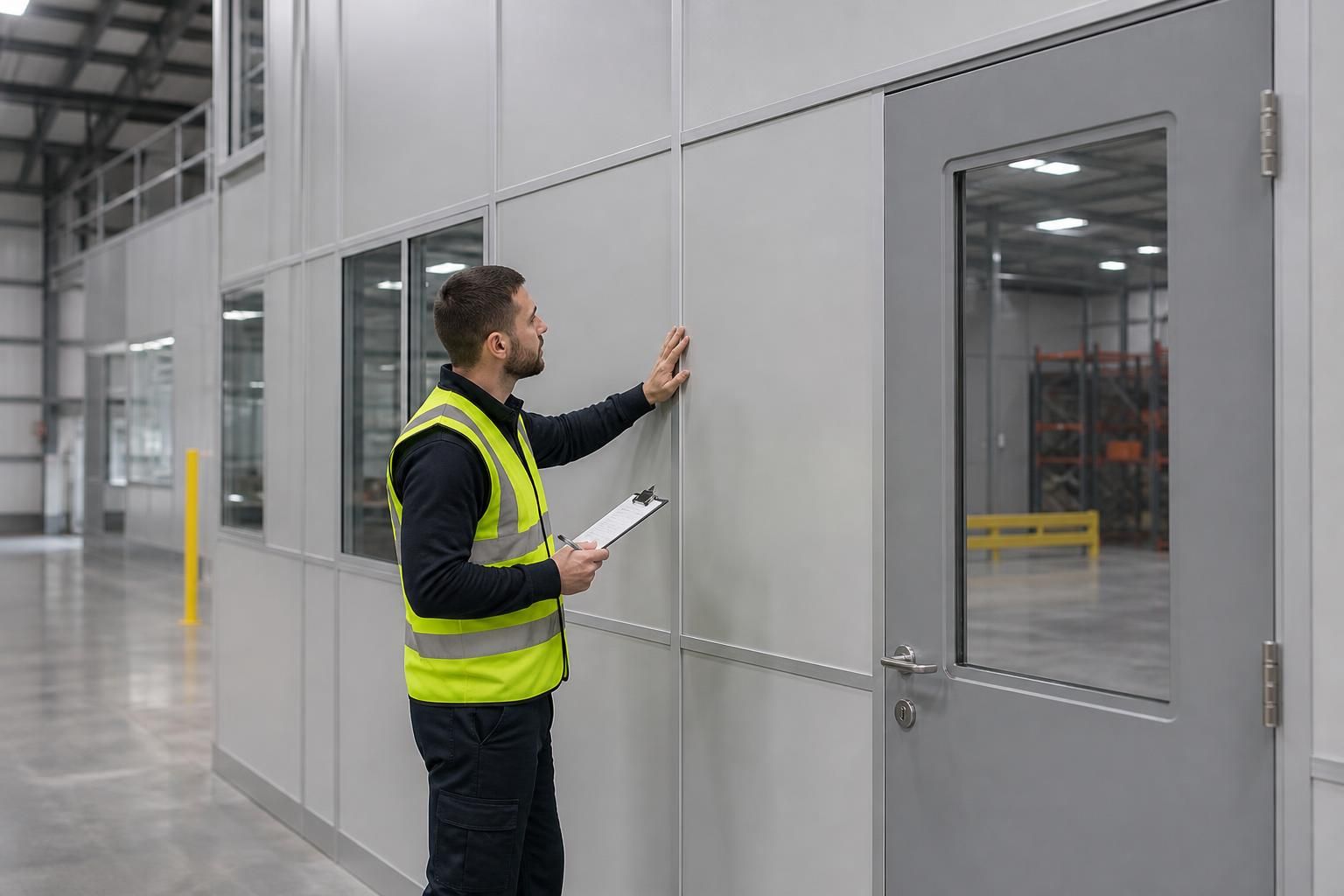
What maintenance should warehouse partitioning receive after installation?
Warehouse partitioning should receive scheduled visual inspections, with checks covering panels, fixings, doors, access points and any attached safety protection.
Record damage, loose components and changes around the partition, then arrange suitable repairs before they affect separation, access or workplace safety.
Warehouse partitioning maintenance should combine routine cleaning, condition checks, controlled alterations and prompt repair. The correct frequency depends on traffic, impact risk, materials, the surrounding environment and your site procedures.
Start with the installation record. Keep the approved drawings, product information and commissioning details with the maintenance records. These documents help you identify the partition’s intended arrangement and any specified fire, acoustic, security or hygiene requirements.
A baseline review after installation gives you a clear reference point. Record the partition’s position, connected structures, door configuration, service penetrations and protective measures. Future changes can then be compared against the original arrangement.
Clean surfaces using suitable methods. Remove dust, deposits and spillages before they affect joints, finishes or visibility. Use cleaning products and equipment compatible with the panel and frame materials. Avoid methods that scratch surfaces, force water into joints or damage protective coatings.
Pay particular attention to areas beside loading routes, production equipment and waste-handling points. These locations can accumulate dirt or suffer repeated contact from vehicles, stock and handling equipment.
Check structural condition during planned reviews. Look for movement, distortion, corrosion, damaged finishes and gaps that were not present at installation. Examine connections between panels, posts, tracks, floors, walls and ceilings where applicable.
Do not treat a partition panel as a storage support unless the design specifically allows that use. Unplanned shelving, brackets, signs, cables or equipment can transfer forces into the partition.
Keep doors and hardware functional. Confirm that leaves move freely, hardware remains secure and the door closes as intended. Check hinges, handles, locks, closers, guides, vision panels and thresholds where fitted.
Remove obstructions from door routes and avoid storing stock against operating areas. Report sticking, dragging, unusual movement or damaged hardware before access becomes difficult.
Protect the partition from vehicle impact. Review the clearance between the partition and forklift, pallet truck or other traffic routes. Inspect nearby barriers, bollards and guardrails after any collision or change to vehicle movement.
Impact can damage internal components without leaving an obvious mark on the visible face. Isolate an affected area where necessary and arrange an appropriate assessment before continued use.
Control alterations and service work. Do not cut panels, move posts or create openings without checking the approved arrangement first. Cable, pipe, ventilation and sprinkler work can affect the partition’s performance or stability.
Any new penetration should receive a suitable detail and finish. Where the partition forms part of a specified fire-resisting enclosure, preserve the documented construction and reinstate affected areas appropriately.
Ask the relevant building, fire or safety professional to review changes when the partition’s original function could be affected. Keep records of the alteration, approval, contractor and completion date.
Set maintenance triggers as well as planned reviews. Reassess the partition after:
- a vehicle impact or significant contact;
- water ingress, flooding or persistent condensation;
- building work near the partition;
- changes to storage, machinery or pedestrian routes;
- relocation of doors, services or attached equipment;
- visible corrosion, movement, damage or unexplained noise.
These events can justify an additional assessment, even when the next planned review is not due. Your risk assessment should identify who reports defects and who decides whether an area remains usable.
Use a clear maintenance record. Note the inspection date, location, observed condition, required action and completion date. Add photographs where they clarify the issue, particularly around impact damage or altered service routes.
Separate minor cleaning from work requiring a trained or suitably experienced contractor. Do not improvise repairs with unapproved fixings, sealants or panel materials. A repair should restore the intended arrangement rather than conceal the visible defect.
We can review warehouse partitioning as part of a wider storage or workplace assessment. Our process may include a site meeting and survey, followed by written proposals and working drawings where changes are needed.
Spartan Direct Limited also provides installation and aftercare for storage and workplace systems. A review can help connect partition maintenance with pallet racking, safety barriers, access routes and future layout requirements.
For larger changes, project management may continue from proposal and tender stages through installation and final commissioning. This gives you a documented handover point before the revised area returns to normal use.
A maintenance plan should reflect the partition’s purpose, not just its appearance. Set clear inspection criteria for separation, access and protection, then compare findings against the approved arrangement.
Use the partition plan to identify higher-risk sections, such as corners beside traffic routes or areas exposed to frequent handling. This helps you direct attention where deterioration could affect warehouse operations first.

Discuss your warehouse partitioning maintenance requirements
Discuss your warehouse partitioning maintenance requirements with us, including damage, access concerns or planned changes. We can consider the partition alongside surrounding storage and workplace arrangements before you decide on further work.



