Which coil racking option suits your handling equipment?
Choose the coil racking option that matches handling equipment access, coil dimensions, load requirements and the movement your workflow demands.
We can assess these factors through a site survey, then provide written proposals and working drawings for comparison.
The right coil racking option follows the way your handling equipment approaches, lifts and places each coil. Forklift-served storage needs clear fork access, suitable aisle space and enough height for the mast and load. Crane-served storage needs an unobstructed lifting path, adequate hook clearance and a controlled set-down position.
Start by mapping the complete handling movement, rather than choosing a rack from its appearance. Record where coils arrive, how equipment collects them, the direction of travel and where operators need to position loads. This shows whether the storage arrangement supports the whole movement or creates extra transfers.
Forklift-handled coils
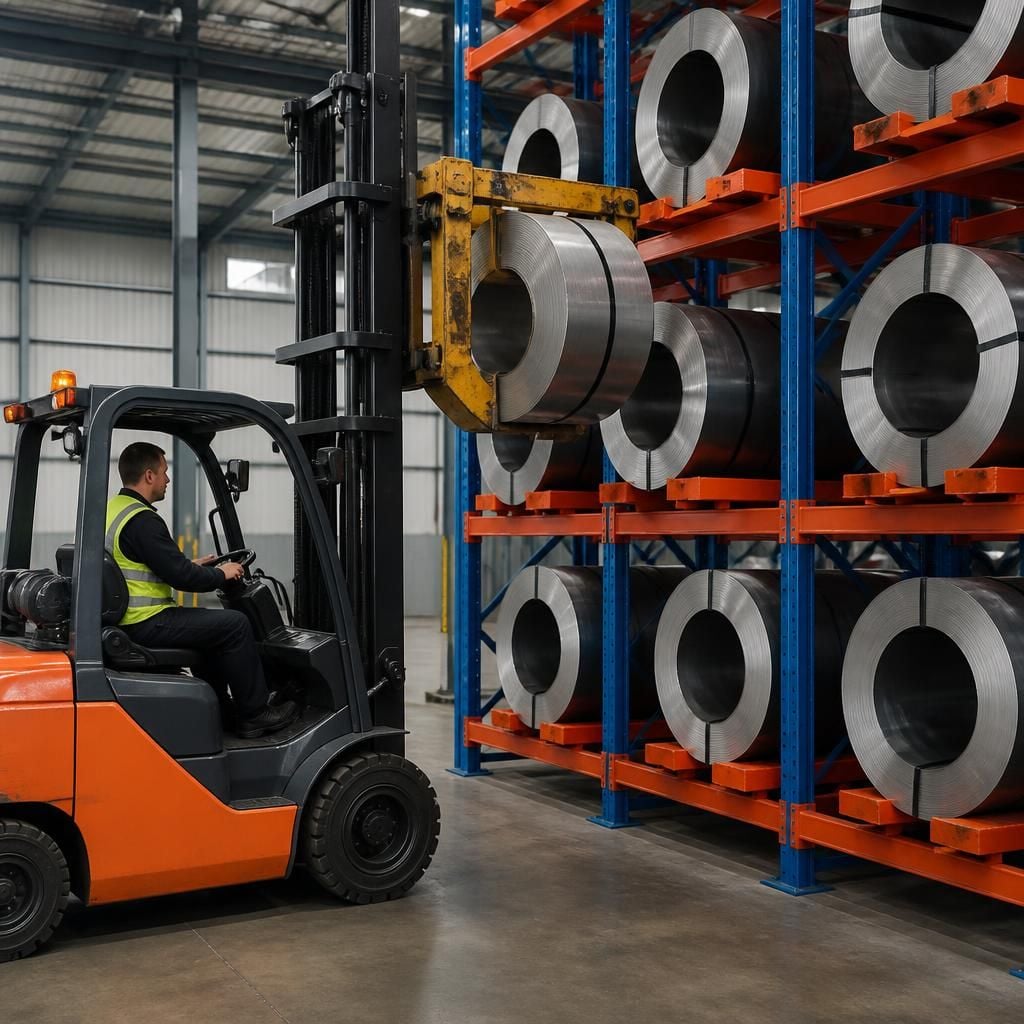
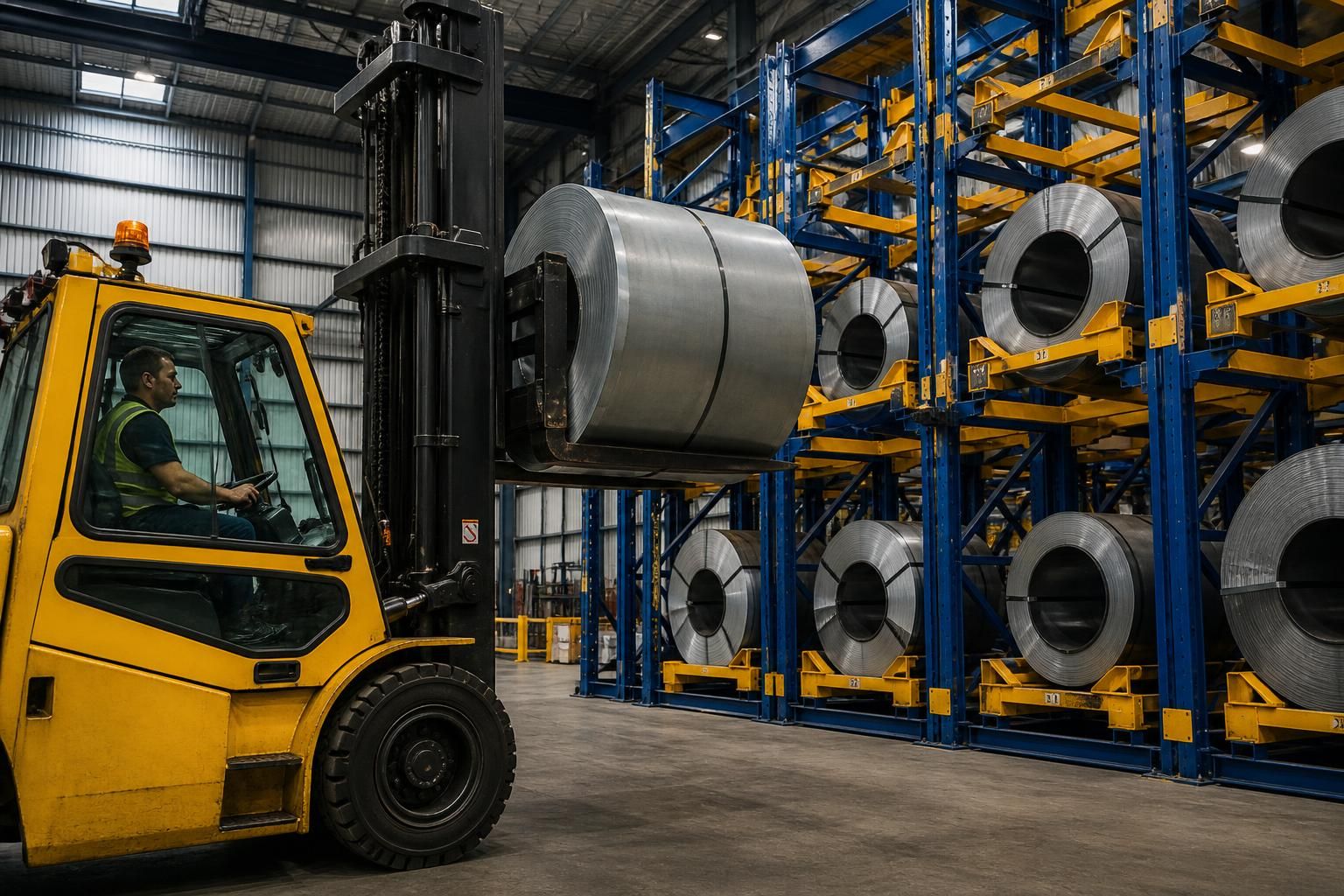
A forklift-based option can suit storage where coils are collected from the floor or rack face. The arrangement must allow the forks to enter without contacting adjacent coils or rack components. Check the following points:
- Fork length and spacing in relation to the coil support points.
- Load centre and forklift capacity at the required lift height.
- Mast height, overhead obstructions and the highest storage position.
- Turning space for approach, withdrawal and repositioning.
- Operator visibility when carrying wide, heavy or closely stored coils.
Where the forklift needs to approach from more than one direction, the rack layout should reflect that movement. A narrow access point may suit one-way handling but restrict replenishment or retrieval from the opposite side.
Overhead-crane-handled coils
Crane-served storage can suit operations where coils are lifted from above. The rack must work with the lifting attachment, hook travel and set-down method already used on site. Review the crane’s working area, lifting height and travel path before selecting the storage arrangement.
- Allow space for the lifting attachment to engage without striking stored coils.
- Keep the lifting path clear of beams, lighting, doors and other obstructions.
- Provide enough room for the crane to position the coil accurately.
- Consider how the coil is released after reaching its storage position.
- Separate crane movements from pedestrian routes and other vehicle movements.
A crane may provide useful vertical access, but it does not remove the need for orderly storage. The rack still needs defined positions, stable support and clear identification.
Coil cars, transfer equipment and mixed handling
Some sites move coils using transfer equipment before placing them into storage. In that case, the rack should align with the transfer route, stopping position and handover height. Check whether equipment approaches lengthways or sideways, then allow enough clearance for accurate positioning.
Where forklifts and cranes both serve the same stock, one arrangement may not suit every movement. Separate storage zones can reduce conflicting access requirements. Each zone should have a clear handling method, defined approach and suitable protection from nearby traffic.
Match the support arrangement to the coil
Handling equipment is only one part of the selection. Coil weight, width, bore, surface condition and storage orientation affect how the load should rest. A support arrangement must keep coils positioned without creating avoidable contact points or difficult removal.
For example, an arrangement using cradles may suit coils that need defined support. Another layout may suit different coil orientations or access patterns. Cantilever racking may also form part of a coil storage layout where its structure and access method match the loads and equipment.
Do not compare options by usable capacity alone. Consider how often each position is accessed, whether stock turns frequently and whether the handling equipment can reach every position without awkward repositioning. The quickest-looking storage method may create slower movements elsewhere in the process.
Check the surrounding operating space
Measure more than the rack footprint. Review aisle widths, door openings, column positions, floor changes, fire equipment, lighting and adjacent work areas. Note any pedestrian crossings and points where vehicles reverse or turn.
Safety barriers and line marking can define equipment routes and separate handling areas from pedestrian movements. Their position should support the coil racking layout, not obstruct the approach needed by the handling equipment.
Existing buildings often impose limits on height, access and movement. A site assessment can establish whether the selected arrangement fits the available space without requiring a premises move. It can also identify changes needed before installation and commissioning.
How we compare the options
We review the handling equipment, coil characteristics, movement routes and working clearances together. A no-obligation consultation may include a site meeting and survey, followed by a written proposal and working drawings.
Those drawings give you a clearer basis for comparing rack positions, access routes and equipment interfaces. Where a project needs it, we can manage the work from proposal and tender stages through installation and final commissioning.
Choose the option that lets the handling equipment reach each required position predictably, with suitable clearance and defined separation. If equipment, stock or workflow may change, discuss those requirements before the arrangement is fixed.
Compare each option against the full loaded envelope, including the coil, lifting attachment, forks and handling equipment.
A position that suits an empty truck may restrict movement once the coil is lifted. Check the highest point, widest projection and stopping position together. This comparison helps you identify access limits before selecting the rack arrangement.