


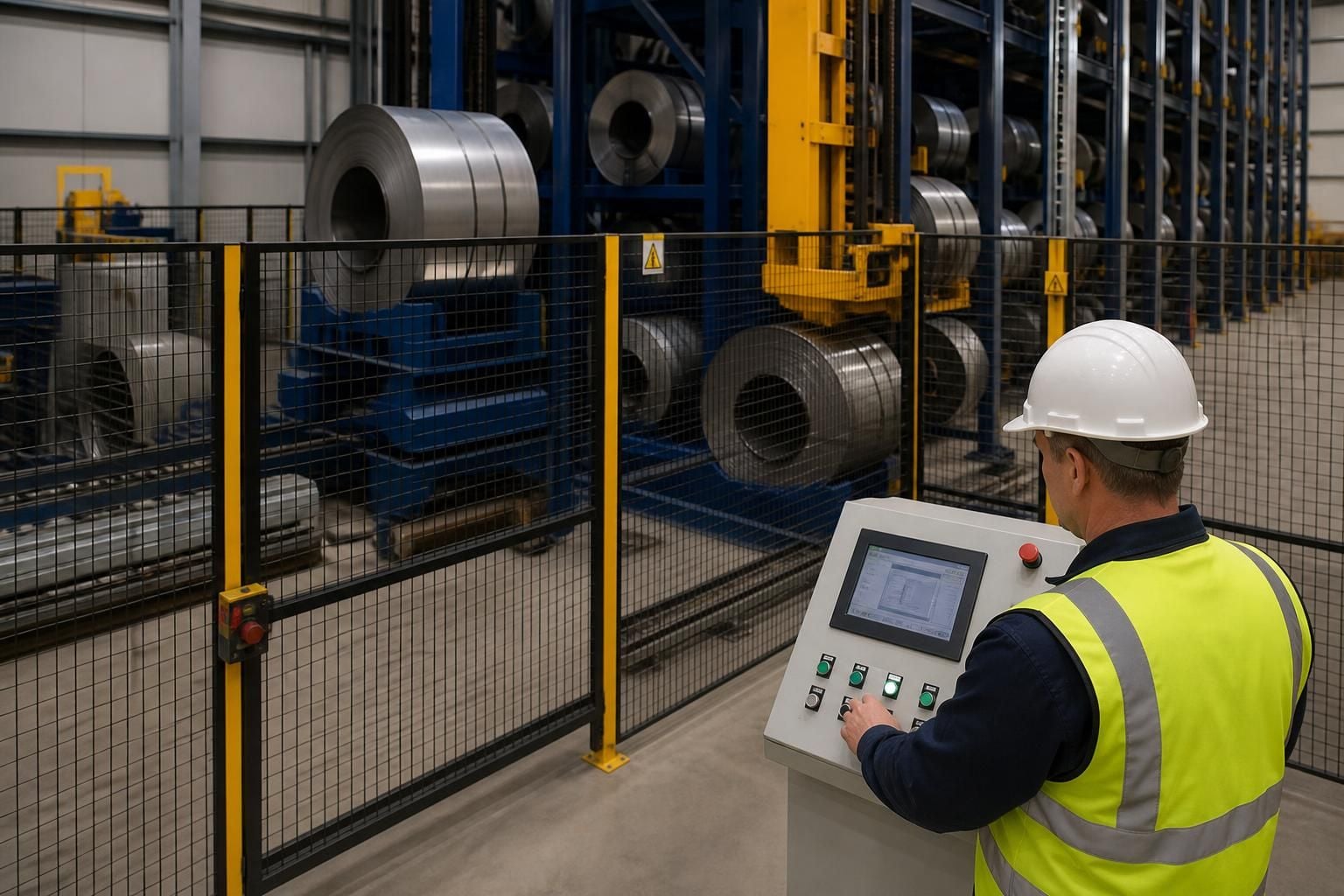
What safety checks should automated coil storage include?
Automated coil storage should include checks on load limits, coil positioning, racking, moving equipment, guarding, access routes and emergency controls.
Record inspections, investigate defects promptly and review the system against equipment instructions and site risk assessments before continued use.
Automated coil storage should have documented checks covering the structure, controls, software, access arrangements and operating conditions. The checks should reflect the system design, coil characteristics, site risk assessment and equipment instructions.
Before commissioning, check the installation. Confirm that the storage structure, supports, rails, cradles and handling equipment match the approved drawings. Check anchoring, floor condition, clearances and alignment before placing coils into storage. Any change from the design should be recorded and assessed before operation.
- Confirm each storage location has the correct identification and location data.
- Check sensors detect occupied, empty and incorrectly positioned locations.
- Test that the system prevents movement when a door, gate or access point is open.
- Verify light curtains, presence sensors and other protective devices stop hazardous movement.
- Check emergency stops remove the relevant movement hazards and require a controlled reset.
- Test alarms and warning indicators so operators can identify the system state.
Check coil stability before every automated cycle. Inspect coils for damaged edges, loose banding, deformation or contamination that could affect handling. Confirm the coil sits correctly in its cradle or support, with no part projecting into the travel path. A coil that does not meet the agreed handling requirements should be isolated until its condition is assessed.
Coil information should remain linked to the storage record. This can include weight, dimensions, material condition and any handling restrictions. The control system should prevent a transaction that would place a coil in an unsuitable location. Operators should not bypass these restrictions without a documented procedure and authorisation.
Check the control and recovery arrangements. Operators need clear instructions for starting, stopping, isolating and recovering the equipment. Test the response to power loss, communication failure, sensor faults and an interrupted movement. Confirm that recovery does not require people to enter a hazardous area unnecessarily.
Manual access should have a defined purpose, controlled entry and isolation method. Check that stored energy has been released or restrained before anyone enters the equipment zone. A reset should not restart movement unexpectedly. The procedure should identify who can authorise recovery and how the event is recorded.
Inspect the physical condition at planned intervals. Look for impact damage, distortion, loose fixings, worn guides, damaged guards and changes in floor condition. Examine cables, connectors, sensors and visible moving parts for damage or deterioration. Check that protective devices remain correctly positioned after maintenance or nearby building work.
Set inspection intervals from the equipment instructions, risk assessment, operating conditions and findings from previous checks. A competent person should carry out examinations that require technical judgement. If the equipment lifts or moves loads in a way covered by lifting-equipment duties, establish whether a statutory thorough examination applies.
Check the surrounding workplace. Keep pedestrian routes, escape routes, loading areas and access to isolation points clear. Confirm that barriers remain secure and that floor markings still identify the intended separation. Review lighting, visibility and housekeeping where they affect safe interaction with the system.
Review the assessment when coil sizes, weights, packaging, software, storage locations or operating methods change. New racking, mezzanine floors, office fit-outs, partitioning or safety barriers can alter access and sightlines around automated equipment. The revised arrangement should be checked before normal use resumes.
Keep evidence that checks have been completed. Records should identify the equipment, date, person carrying out the check, findings and required action. Record isolations, repairs, replaced parts, overrides and repeat faults. Close out defects formally rather than relying on verbal instructions.
Do not return equipment to service after a safety-critical defect until the responsible person has assessed it. Where a material defect concerns supplied materials, notify the supplier in line with the applicable terms. The response may involve repair, replacement or a refund of the relevant price, at the supplier’s discretion.
A site survey, written proposal and working drawings can help define these checks before installation. Spartan Direct can also coordinate project management through installation and final commissioning where required. This gives you a documented basis for operating, inspecting and reviewing the automated coil storage arrangement.

Safety checks should also cover the operator interface. Confirm that status messages, alarms and fault codes are clear from the control position, without requiring entry into the guarded area.
During handover, walk through normal storage, retrieval and fault scenarios using the supplied instructions. Check that operators can identify the affected location, understand the required response and recognise when isolation or technical support is necessary.



