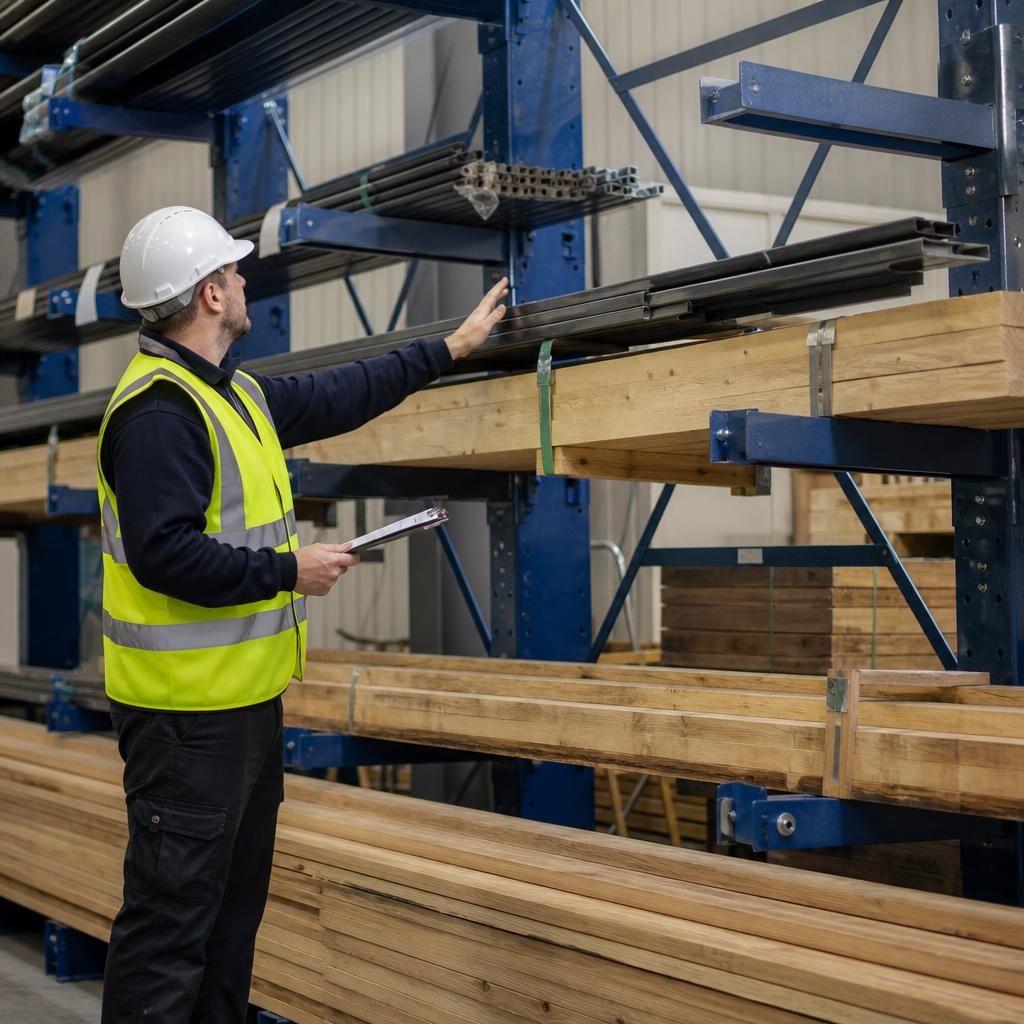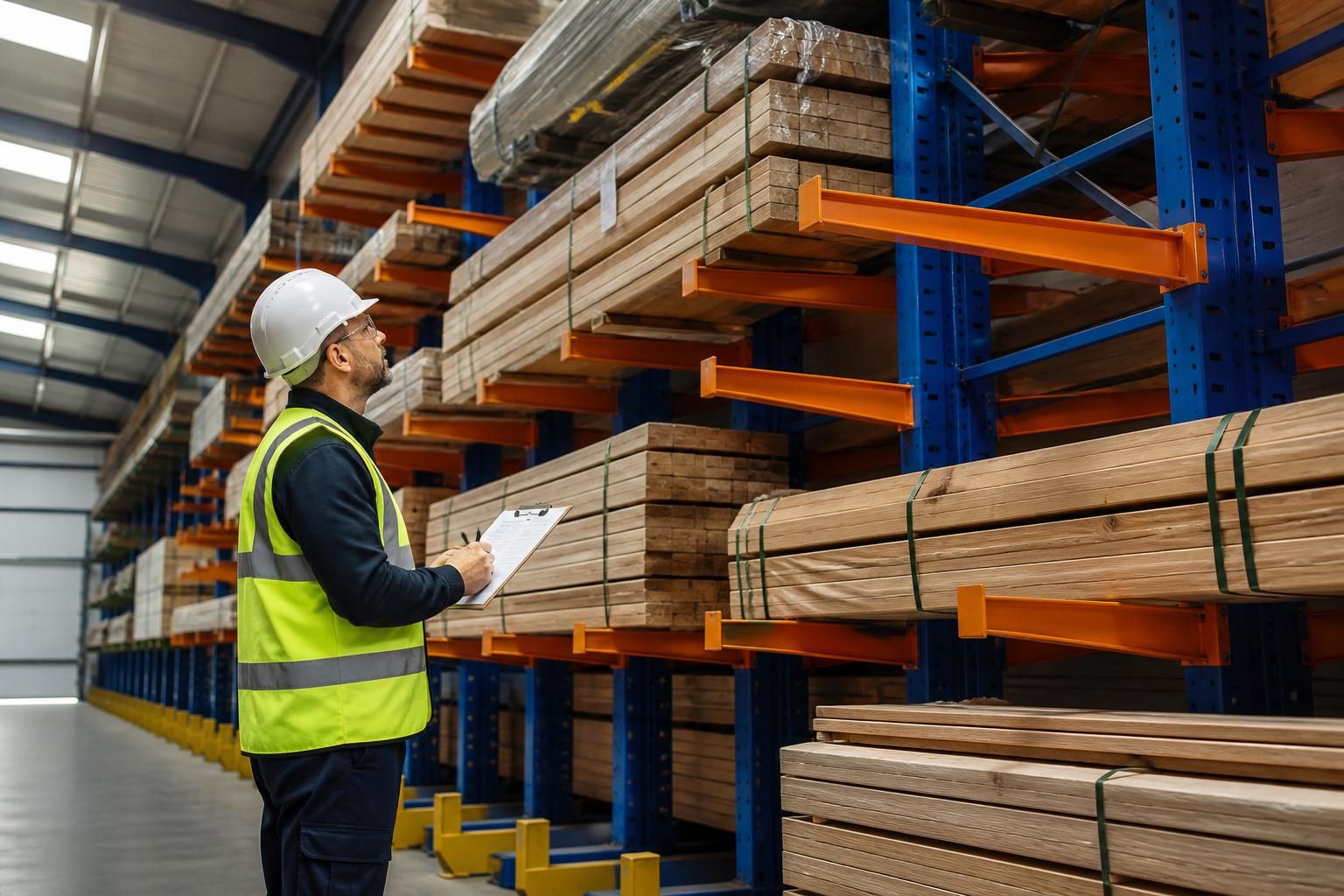
What should be checked during cantilever racking inspections?
Cantilever racking inspections should check uprights, arms, bracing, baseplates, anchors, load notices, end stops and impact damage. Record defects, restrict unsafe sections where necessary, and arrange suitable remedial work before continued use.
Cantilever racking inspections should assess condition, loading, stability, operation and records. The inspection should identify risks, rate their seriousness, and define action before unsafe storage continues.
Start with the racking’s intended use
Compare the installed arrangement with its design information and current storage demands. Check that stored materials match the stated load type, dimensions and distribution.
Pay particular attention to changes since installation. Different stock, heavier bundles, altered storage levels or revised handling equipment can change the risk profile.
- Confirm that load information remains available and understandable to operators.
- Compare actual bundles with the stated capacity and permitted storage arrangement.
- Check that loads sit within the intended support area and do not create unstable overhangs.
- Review changes to aisle widths, traffic routes and nearby workplace activities.
Assess condition, not just presence
An inspector should assess the severity, position and likely cause of each defect. Minor surface marking differs from distortion that affects alignment or structural behaviour.
Look for recurring damage across several bays. A repeated pattern may indicate forklift contact, unsuitable handling routes, uneven loading or an installation issue.
Inspectors should also consider corrosion, deterioration, loose connections, missing components and signs that the system has moved. The surrounding floor and traffic environment may provide important context.
Review operational controls
Inspection should consider how people load, unload and work around the racking. Safe access depends on clear routes, controlled vehicle movements and suitable handling practices.
- Check that handling equipment can approach without striking the structure or stored materials.
- Assess whether loads can be placed and removed without forcing contact.
- Look for storage that projects into access routes or obstructs visibility.
- Confirm that operators can identify capacity information and follow the intended loading method.
Where workplace changes have introduced new traffic or storage patterns, reassess the arrangement rather than relying on an earlier report.
Record findings in a usable format
A useful inspection report should identify the exact location, describe the defect, explain the risk and assign a clear action. Photographs can support the written finding where they show scale or position.
Record the inspection date, the areas examined and any sections that could not be accessed. Note temporary controls, responsible actions and the required follow-up.
Do not close a finding simply because a repair has been requested. Confirm that the remedial work is complete and that the affected area has been reassessed.
Act according to the finding
Findings requiring immediate control should lead to suitable restrictions, unloading or isolation. Less serious issues still need recording and planned correction.
- Remove damaged stock only where doing so does not create additional risk.
- Prevent further use of affected positions when structural condition is uncertain.
- Arrange assessment before straightening, drilling, welding or replacing components.
- Update records after remedial work and communicate any revised loading conditions.
Do not treat paint, local straightening or a replacement part as proof that the underlying cause has been resolved.
Use inspection as part of ongoing control
Regular user observations, recorded internal checks and more detailed inspections serve different purposes. Your inspection arrangements should reflect the equipment, environment, handling activity and history of damage.
Keep reports with relevant drawings, load information, repair records and previous findings. This allows changes to be compared instead of assessed in isolation.
We provide racking inspections and aftercare for businesses reviewing cantilever storage. Our process can consider the installed arrangement, working practices and any remedial requirement before you decide on further work.
Cantilever racking inspections should distinguish confirmed defects from uncertainty. Do not infer load capacity, component suitability or structural performance from appearance alone. Check available design information, component details and loading requirements before reaching a conclusion.
Where records conflict, modifications are undocumented or critical information cannot be verified, record the limitation clearly. A further technical assessment may then be needed before the affected section returns to normal use.