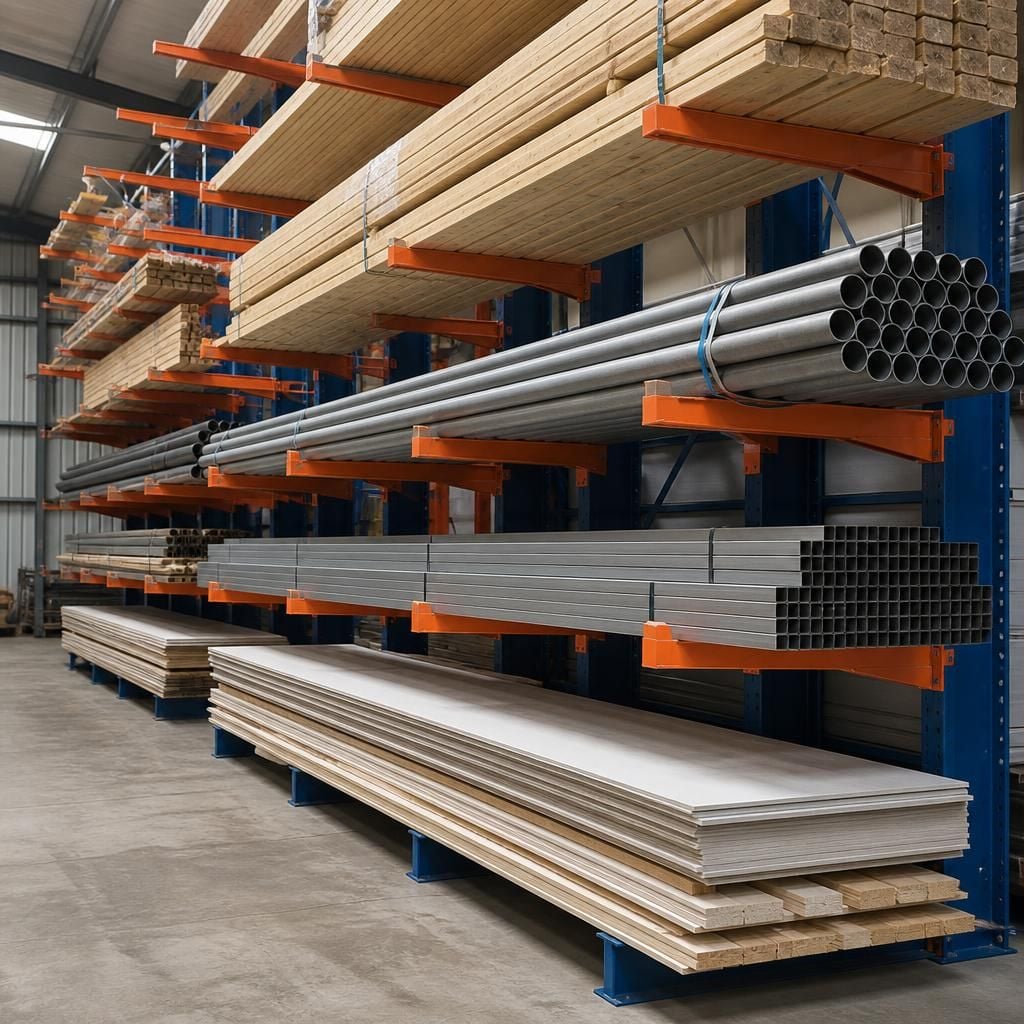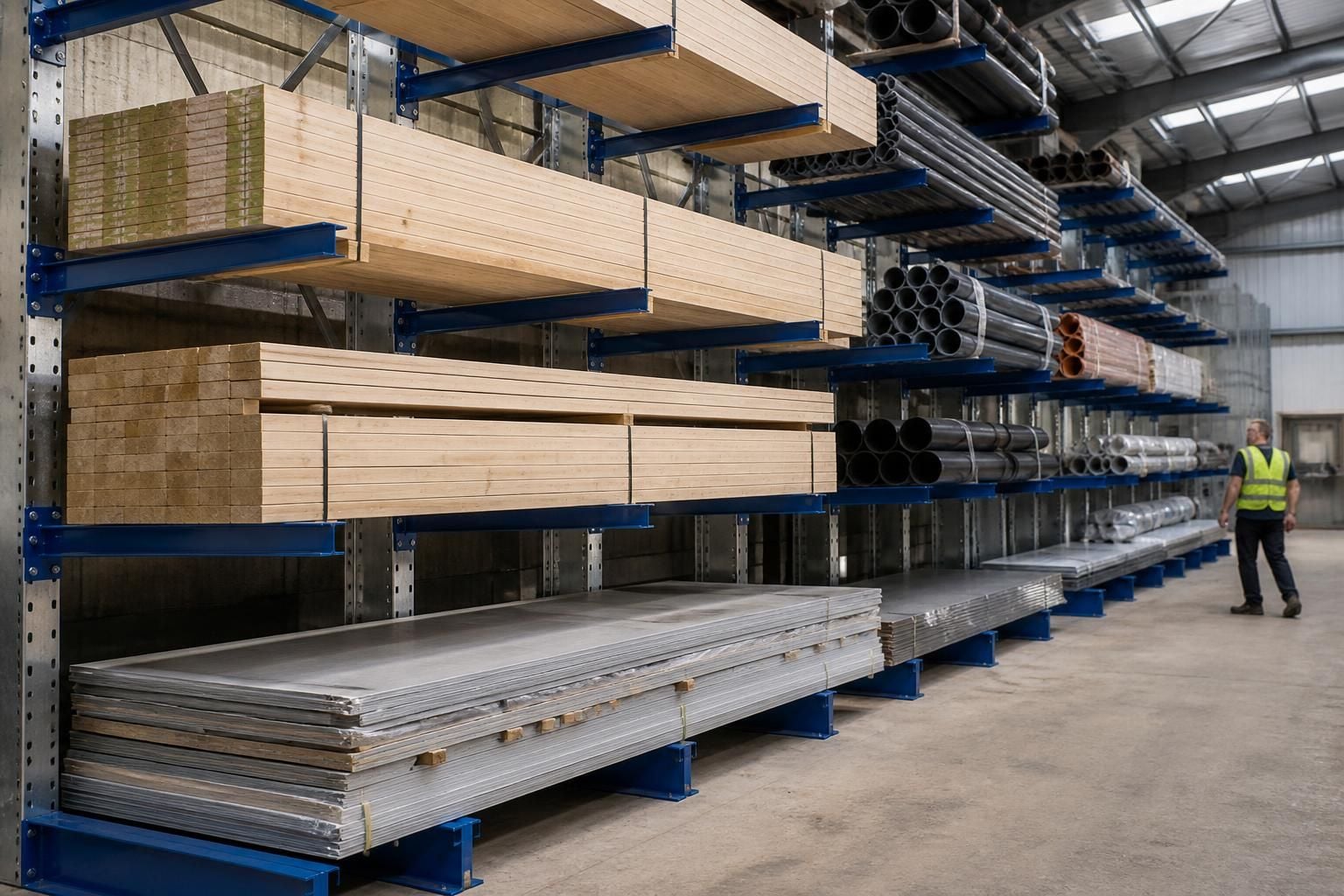
What arm length suits pipes, timber and sheet materials?
Cantilever racking arm length should suit the stock depth, load distribution and access clearance, rather than follow one standard measurement.
We assess pipes, timber and sheet materials during a site survey, then show suitable dimensions in written proposals and working drawings.
Choose cantilever racking arm length from the loaded stock depth, support method and required access clearance. The correct length supports the material securely without creating unnecessary projection into aisles or working areas.
Measure the stock as it will be stored, rather than measuring one individual item. A bundle of timber, a group of pipes or a pack of sheets may have a different loaded depth from the materials themselves.
- Pipes: consider the outside diameter, how the pipes nest, and whether several sizes share one level. Bundles can project further than individual pipes.
- Timber: measure the full depth of each pack, including uneven ends and protective wrapping. Different timber lengths may also require separate storage positions.
- Sheet materials: measure the pack depth and consider how the sheets are loaded. Flat-stored packs need consistent support across their depth.
The arm should provide enough bearing area for the load without leaving excessive unsupported material. Extra length does not automatically improve storage. It can reduce aisle clearance, increase obstruction risk and make loading less controlled.
Short arms can create a different problem. If stock projects too far beyond the support, the load may become harder to place and remove safely. The projection can also affect how the racking fits beside walkways, doors, machinery or other storage.
Arm length also depends on how you access the stock. Forklift loading requires clearance for the vehicle, fork entry and the pack being positioned. Manual handling may need space for people to place, separate or retrieve individual items. The arm length must work with the planned handling method, not just the stock dimensions.
Mixed stock usually needs closer consideration than a single product type. Pipes may need a different effective depth from timber packs, while sheet materials may require wider support or additional decking. Using one arm length for every item can leave some stock unsupported or waste available space.
The required load is also relevant. A longer arm can change the forces applied to the racking upright, particularly when the load sits towards the arm’s outer end. Arm length and capacity therefore need checking together. The working load should reflect the heaviest planned pack, its position and the number of loaded levels.
Stock dimensions should be reviewed in relation to the total bay arrangement. Upright spacing, the number of arms per level, aisle width and the height of stored materials all affect the usable storage position. Arm length alone cannot determine whether a layout will function safely.
For sheet packs, check whether the material needs continuous support, intermediate supports or a different storage arrangement. Thin or flexible products may need more support than rigid packs, even when both have the same measured depth.
During a consultation, we can review the stock dimensions, handling equipment and available layout. A site meeting and survey can inform written proposals and working drawings. These documents can show the selected arm dimensions and their position within the planned racking.
Allow for future stock changes before fixing the dimensions. If pipe diameters, timber pack sizes or sheet formats vary, record the largest regular load and identify items needing separate positions. This helps prevent later overhangs or blocked access.
For commercial and industrial sites across the West Midlands, Spartan Direct can coordinate the design and installation of cantilever racking where required. The aim is organised long-stock storage that fits the stock, access method and working layout.
Check the drawing’s dimension references before ordering. Arm length describes the support projection, while stock depth, bay width and aisle clearance describe different parts of the layout.
A clear plan view should show the arm projection, the loaded material depth and the space remaining around the rack. This makes it easier to confirm that pipes, timber packs or sheet materials sit within the intended storage position.