


Which vehicle impact barriers protect columns without narrowing forklift routes?
Vehicle impact barriers protect columns without narrowing forklift routes when their layout follows vehicle swept paths and required clearances. We assess the column positions, traffic movements and available space before proposing suitable safety barriers.
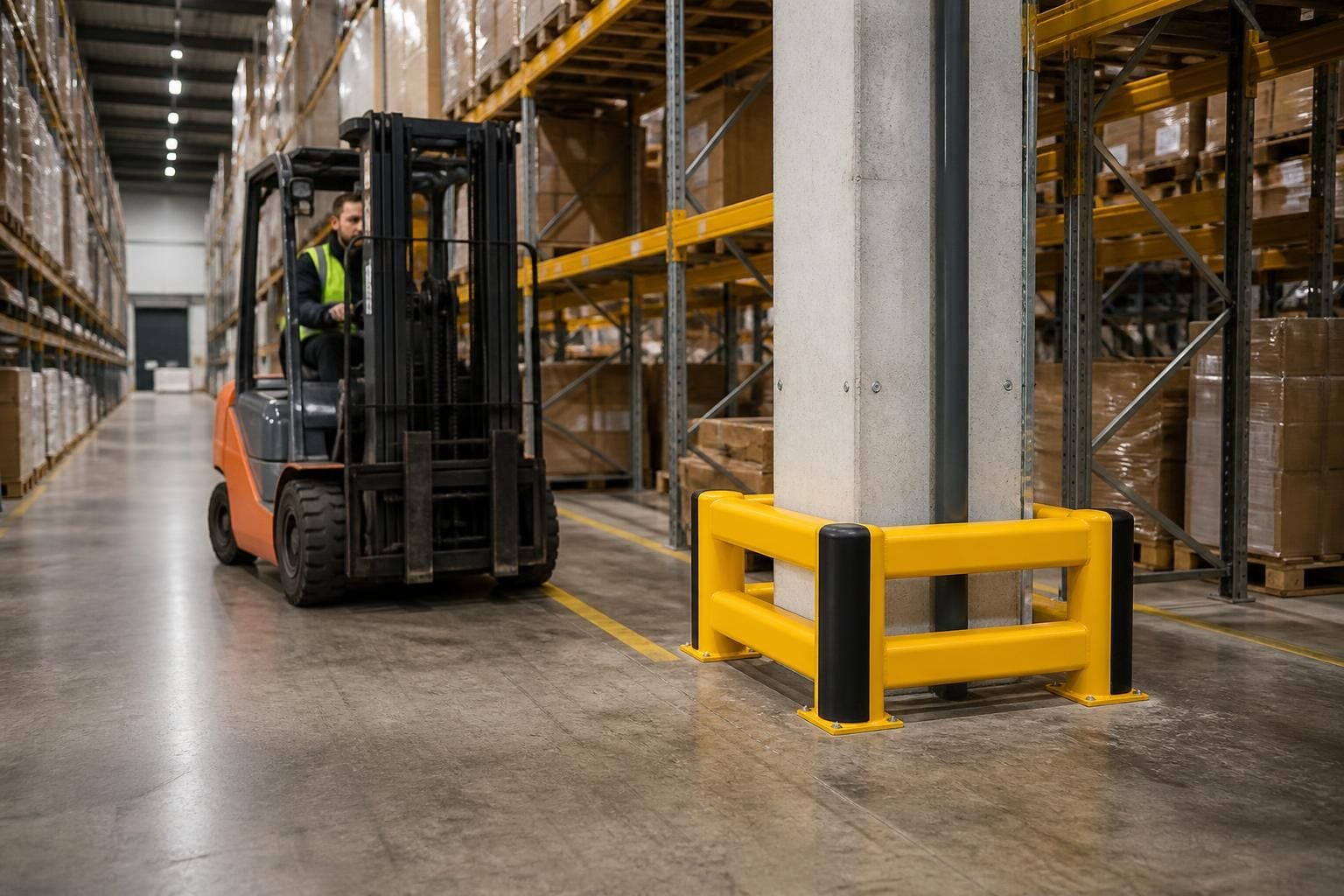
Column protection that preserves forklift routes normally comes from close-fitting guards, short barrier runs or carefully offset protection. The right choice depends on the column’s exposure, vehicle envelope and clearance needed for loads to pass.
Close-fitting column guards suit columns beside active forklift routes. They protect the exposed faces while keeping the barrier footprint close to the obstruction. This approach can preserve more usable aisle width than extending a continuous barrier around the whole area.
Short barrier sections work where vehicles approach from a known direction. They place a physical buffer between the traffic path and the column without creating a long obstruction beside the route. The barrier length should reflect the likely contact points, including turning movements and rear swing.
Individual protective posts may suit corners, isolated columns or locations with limited floor space. They can protect a specific impact point, but each post introduces its own footprint. We therefore consider the post position, vehicle clearance and pedestrian movement together.
Continuous barrier lines are more suitable where vehicles can approach the column from several directions. They can also separate a structural column from a busy work area. However, extending protection too far into an aisle may restrict turning space or reduce access to stock.
Forklift routes need assessment beyond their marked width. We consider the vehicle body, load size, turning arc, mast movement and rear counterweight. The calculation must also account for the barrier’s position and any space needed around it after installation.
- Columns directly beside straight travel lanes may suit close-fitting protection.
- Columns near junctions may need protection that follows the full approach area.
- Columns beside loading or staging areas may need separation from changing vehicle movements.
- Columns at aisle ends require particular attention to turning clearance and load overhang.
Fixing conditions also influence the selection. We review the column shape, surrounding slab, access for installation and any services near the proposed fixing points. A barrier cannot protect the column properly if its position creates a new obstruction or prevents suitable fixing.
Protection should follow the actual traffic arrangement, not simply the column’s outline. A small offset can preserve turning room, while an incorrect offset can place the barrier inside the vehicle’s swept path. Working drawings make these relationships easier to check before work begins.
If the available clearance cannot accommodate both the vehicle and protection, changing the barrier type alone will not solve the problem. The route, traffic direction, storage position or working area may also need review.
We can assess these points through a no-obligation consultation, including a site meeting and survey where appropriate. We then prepare a written proposal and working drawings showing the protection arrangement and its relationship with the route.
For projects involving storage changes, workplace segregation or other safety barriers, we can coordinate the proposal, installation and project management where required. This keeps column protection connected to the wider warehouse layout rather than treating it as an isolated fitting.
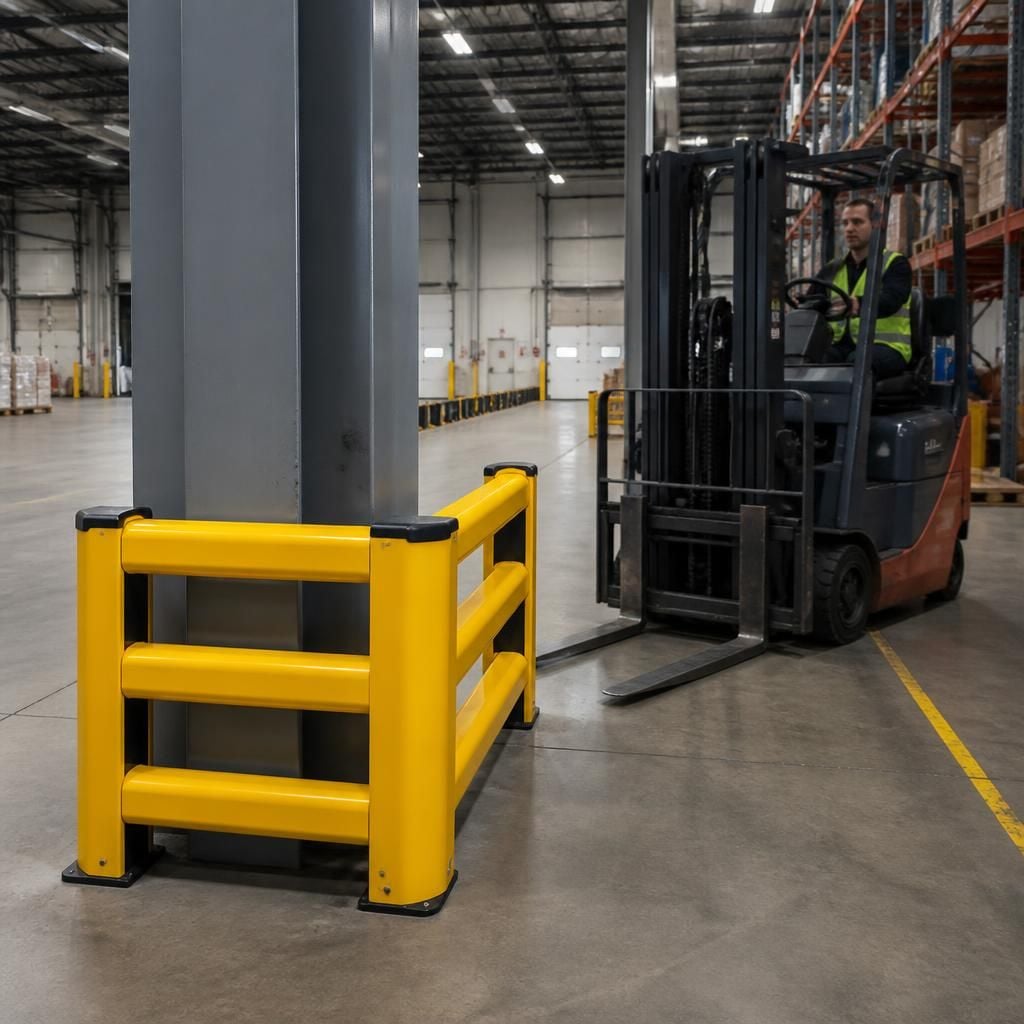
The ends of a column barrier matter as much as its overall width. Angled or returned ends can reduce abrupt edges beside the route, while projecting corners may catch loads or restrict movement.
We check the barrier profile, end position and fixing detail against the forklift’s approach. This helps protect the column while leaving a clean passage for vehicles, loads and pedestrians.



