


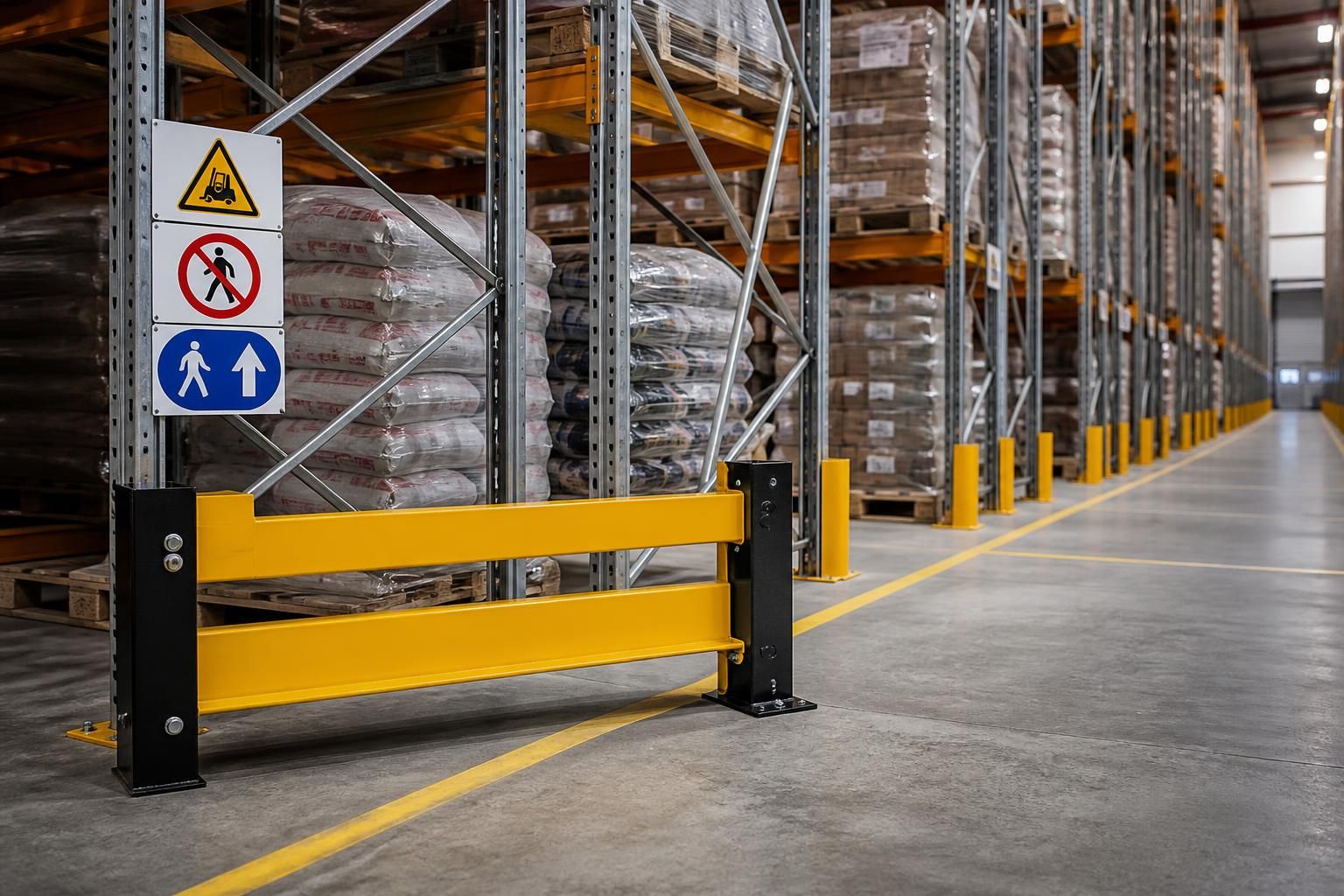
Which racking safety signs should accompany pallet racking protection barriers?
Pallet racking protection barriers should be accompanied by clear warning signs identifying vehicle-impact hazards, restricted areas and required safe behaviour. Place signs where drivers and pedestrians can see them before reaching the barrier, using them to reinforce—not replace—the physical protection.
The signs should match the hazard, traffic movement and access rules around each pallet racking protection barrier. A useful sign set usually combines warning, prohibition, mandatory and directional information.
Vehicle-impact warning signs alert forklift and reach truck drivers to the risk ahead. Use wording or symbols that identify the protected racking, barrier line or vehicle hazard. Place these signs before drivers reach turning points, aisle ends or restricted clearance areas.
Where several vehicle types operate onsite, the sign should reflect the actual traffic risk. Avoid displaying a general warning that gives no useful instruction. Clear symbols can support written wording, particularly where several languages are used.
Restricted-access signs define areas that pedestrians or unauthorised vehicles must not enter. They may apply beside end barriers, loading points, racking corners or temporary protection during site work. The wording should identify the restriction without creating uncertainty about permitted routes.
Examples include:
- Keep clear of racking protection.
- No pedestrian access beyond this barrier.
- Authorised vehicles only.
- Do not stand or store materials within the protected zone.
Use these messages only where they reflect the site’s operating rules. A sign should never instruct people to avoid a route that remains necessary for emergency access or normal work.
Pedestrian-safety signs should support workplace segregation around the racking. Directional signs can identify walkways, crossing points and alternative routes. Where pedestrians and vehicles share an approach, signs should make the expected movement clear before the two routes meet.
Line marking can reinforce this arrangement, but the markings and signs need to agree. A pedestrian arrow pointing towards a restricted area creates confusion. Review signs after changing aisle directions, picking areas or vehicle routes.
Mandatory-action signs communicate behaviour required by the site’s risk controls. These may include instructions to use a marked pedestrian route, follow a traffic direction or wear specified protective equipment. Do not display protective equipment instructions unless the site has identified that requirement.
Speed-limit signs can also support vehicle control where the workplace has set a speed limit. The sign should show the limit used by the site and appear before the relevant hazard. It should not suggest a universal limit for every warehouse area.
Keep-clear and obstruction warnings protect the space needed around barriers, rack uprights, fire equipment, doors and escape routes. These signs are useful where stock, pallets or handling equipment could gradually reduce clearance.
Do not use a keep-clear sign as a substitute for physical housekeeping controls. The surrounding layout should make the required clearance practical. Marked floor areas, barrier positioning and storage rules should all support the same instruction.
Use the recognised colour and symbol conventions for each message. Warning signs commonly use yellow and black. Prohibition signs commonly use red and white. Mandatory signs commonly use blue and white. Safe-condition signs commonly use green and white.
These conventions help readers identify the type of instruction quickly. Select sign sizes that remain legible from the approach distance. Check that racking, stored goods, columns, lighting and vehicle movements will not hide the sign.
Position signs at the driver’s and pedestrian’s approach, rather than only beside the barrier. A sign may need repeating on both sides of an aisle or at each direction of travel. Junctions and turning areas deserve particular attention because users make decisions there.
Fixings should keep the sign secure without creating a new projection or snagging point. Avoid placing signs where fork movements, pallets or wrapping equipment can damage them. If a barrier includes a sign panel, check that the panel remains visible after installation.
Include sign checks within routine workplace inspections. Look for fading, dirt, impact damage, loose fixings and messages that no longer match the layout. Following a collision, inspect the barrier and sign together before returning the area to normal use.
A site survey can review barrier locations, vehicle approaches, pedestrian routes and sign visibility together. We can then set out sign positions within written proposals and working drawings where the project requires it. This helps the protection arrangement support the actual workflow rather than relying on signs alone.
Give each pallet racking protection barrier one clear primary instruction. A driver should understand the hazard, the required action and the relevant boundary without sorting through competing messages.
Use supporting information only when it adds control. For example, pair a vehicle-impact warning with a keep-clear instruction where stored stock could reduce the barrier’s working space. Review the wording against the site’s risk assessment and traffic plan before signs are fixed in place.
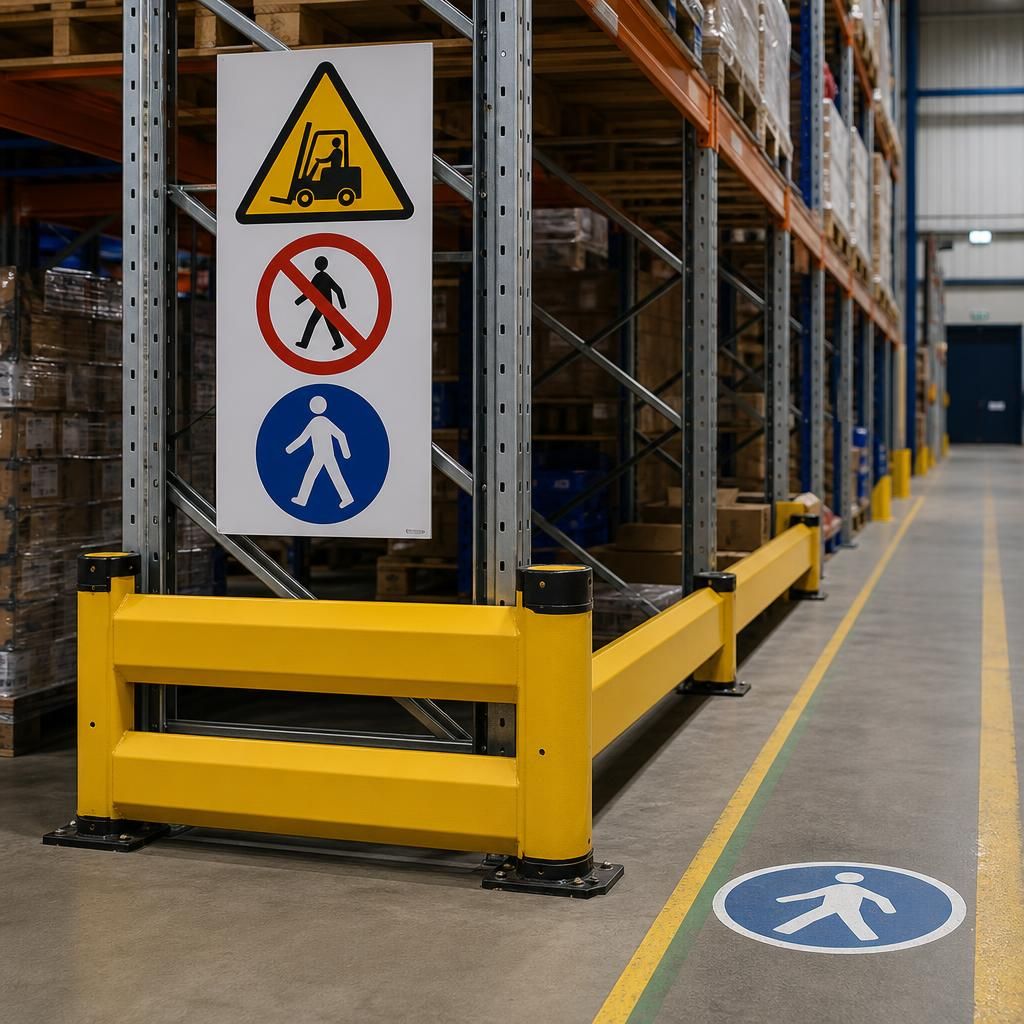
Discuss safety signs for your pallet racking protection barriers
Ask us to review the safety signs supporting your pallet racking protection barriers, including their messages, locations and visibility. We can discuss the site requirements and set out suitable positions within written proposals where needed.



