Which pallet racking protection barrier suits high-traffic warehouse aisles?
For high-traffic warehouse aisles, double-rail pallet racking protection barriers generally provide more continuous separation from vehicle routes than single posts.
Use end-of-aisle barriers where impacts concentrate, assessing traffic, clearance, impact direction and load access before installation.
For consistently busy warehouse aisles, choose a pallet racking protection barrier that separates vehicle movement from rack uprights without restricting stock access. The best option depends on traffic patterns, vehicle type, turning space, rack position and the consequences of an impact.
Continuous barriers for regular vehicle movement
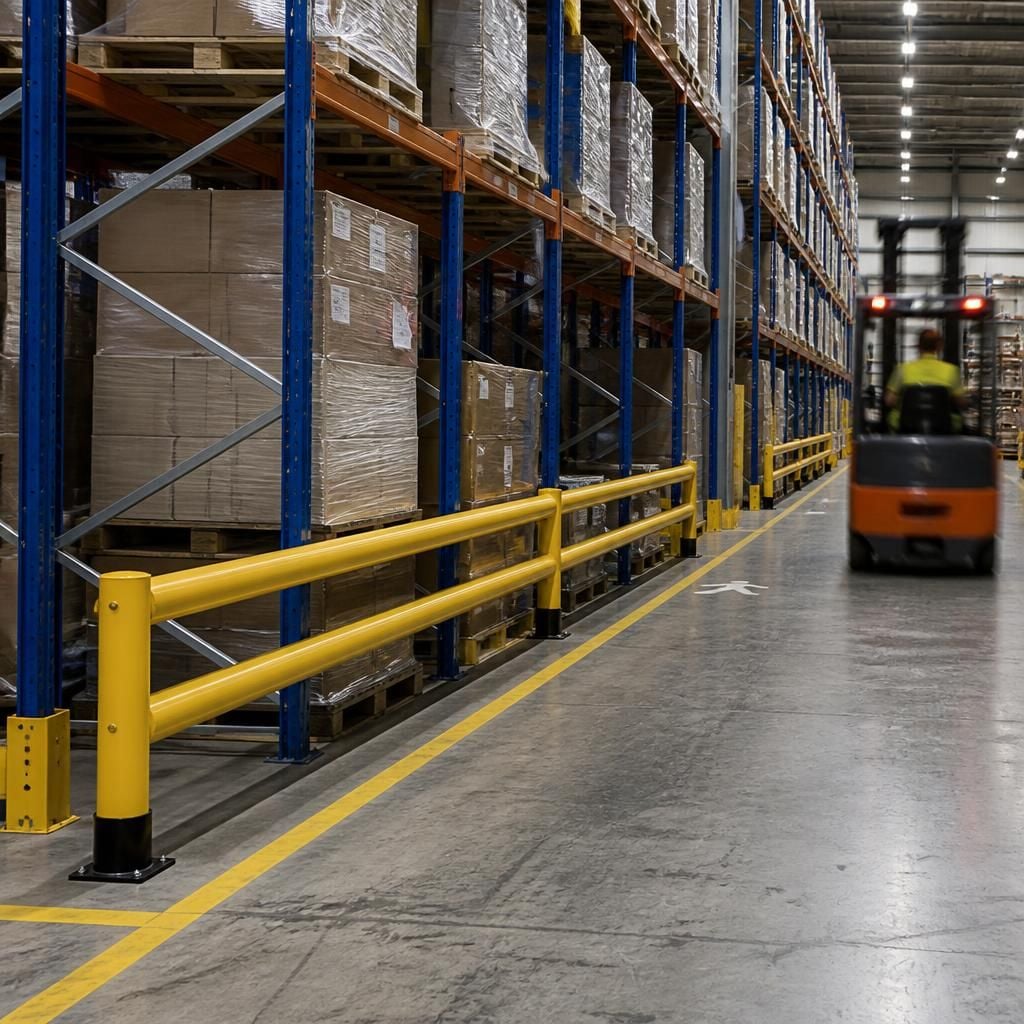
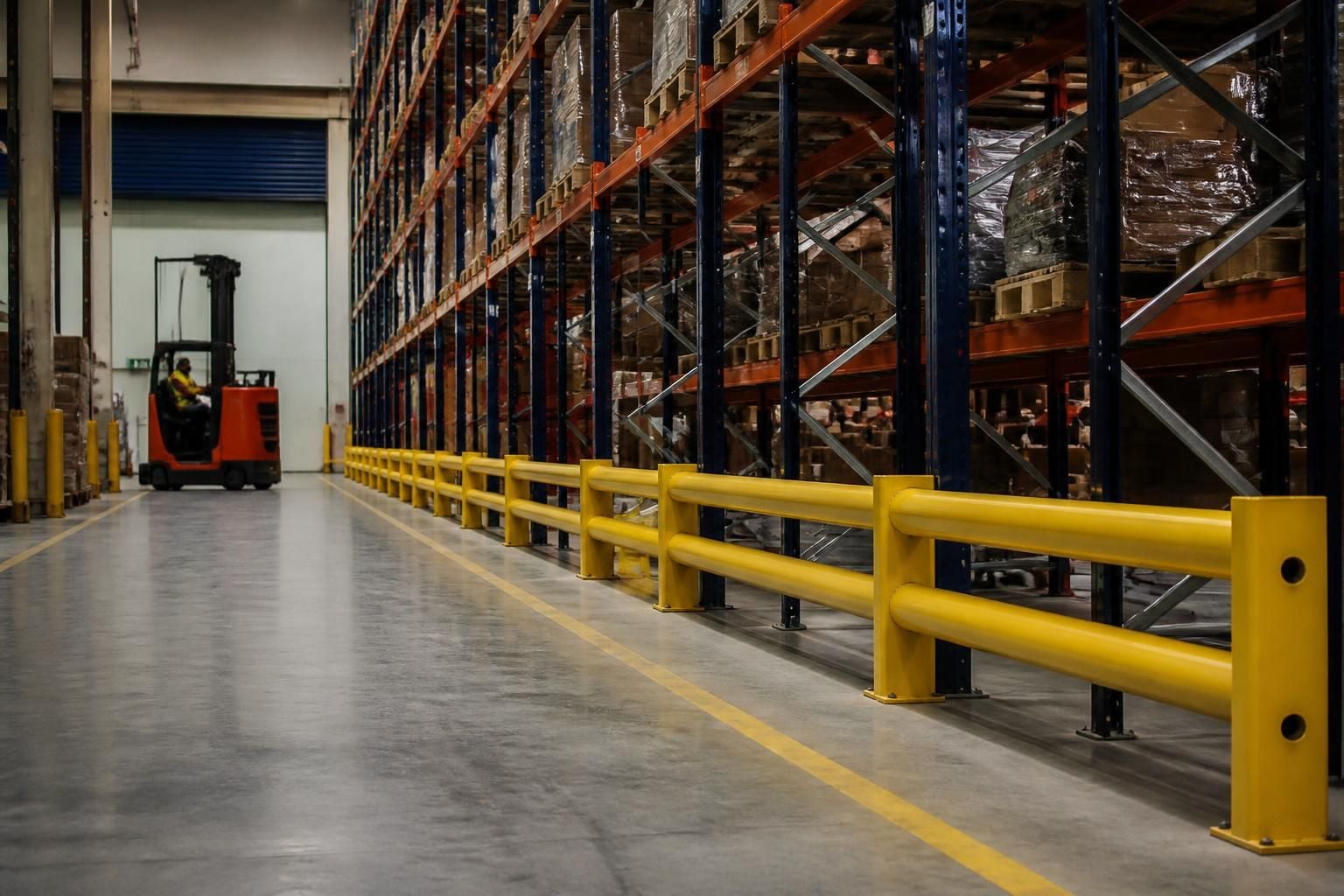
A two-rail pallet racking protection barrier suits routes where forklifts or other vehicles travel alongside racking repeatedly. Its upper and lower rails create a longer protected line than separate posts, helping define the boundary between vehicle routes and storage.
This arrangement can suit long rack runs, loading approaches and areas where vehicle movement stays close to the racking. Check the rail position against pallet dimensions, fork movement and the clear aisle width before selecting it.
End protection for turning and approach points
At aisle entrances, vehicles often turn towards rack ends rather than travel parallel with them. An end-of-aisle barrier can therefore suit concentrated approach risks at these locations.
It may be used alongside protection along the rack face where traffic continues beyond the aisle entrance. The correct combination depends on the vehicle path and the parts of the racking exposed to impact.
Single rails and posts for restricted locations
A single-rail barrier or individual protective post may fit locations where a larger frame would obstruct access, visibility or a working route. These options can suit isolated exposure points, service areas and places with limited floor space.
They should not be selected simply because they occupy less space. Consider the likely impact direction, vehicle mass, travel speed and the width available for safe manoeuvring.
Use these checks before choosing a barrier
- Traffic pattern: Map vehicle routes, reversing movements, crossing points and pedestrian access.
- Impact direction: Identify whether contact is likely along the rack face, at the rack end or during turning.
- Clearance: Confirm that the barrier does not reduce safe access for forklifts, pallet trucks, operators or emergency movement.
- Stock handling: Check that pallets can enter and leave storage without striking the rails or posts.
- Visibility: Avoid creating an obstruction that hides rack locations, pedestrians or vehicle movements.
- Floor conditions: Review the available fixing positions and the condition of the concrete before installation.
- Future layout: Allow for changes to rack runs, access routes, workstations and pedestrian segregation.
Do not judge protection by appearance alone
A substantial-looking barrier may still be unsuitable if it sits too close to the rack or leaves the exposed upright outside its protected zone. A smaller barrier may also be unsuitable where vehicles approach from several directions.
Protection should work with the racking layout rather than reduce the usable aisle. It should also leave enough access for inspections, stock handling and routine work around the storage system.
How we assess the right option
We can review the warehouse layout, traffic movements, rack positions and access requirements through a no-obligation consultation. A site meeting and survey can identify exposed areas that are not obvious from a plan.
We then prepare written proposals and working drawings for the pallet racking protection barriers. These can show barrier positions, access points and the relationship between vehicle routes and racking.
Where a project includes wider storage or workplace changes, project management may continue from proposal and tender stages through installation and final commissioning.
Spartan Direct has worked on storage systems for companies of different sizes across the UK since 1982. For warehouses in the West Midlands, that process provides a practical basis for comparing barrier types before work begins.
The suitable choice is the barrier arrangement that protects the exposed racking, preserves necessary access and reflects actual traffic movement. A site survey and working drawing can test those points before installation.
Pallet racking protection barriers should make the boundary between storage and vehicle movement clear at a glance. A consistent barrier line can support workplace segregation by showing where vehicles should travel and where rack access begins.
Review the proposed arrangement with the people using the aisle. Their knowledge of reversing, loading and pedestrian movement can highlight practical conflicts before the protection barriers are fixed in place.