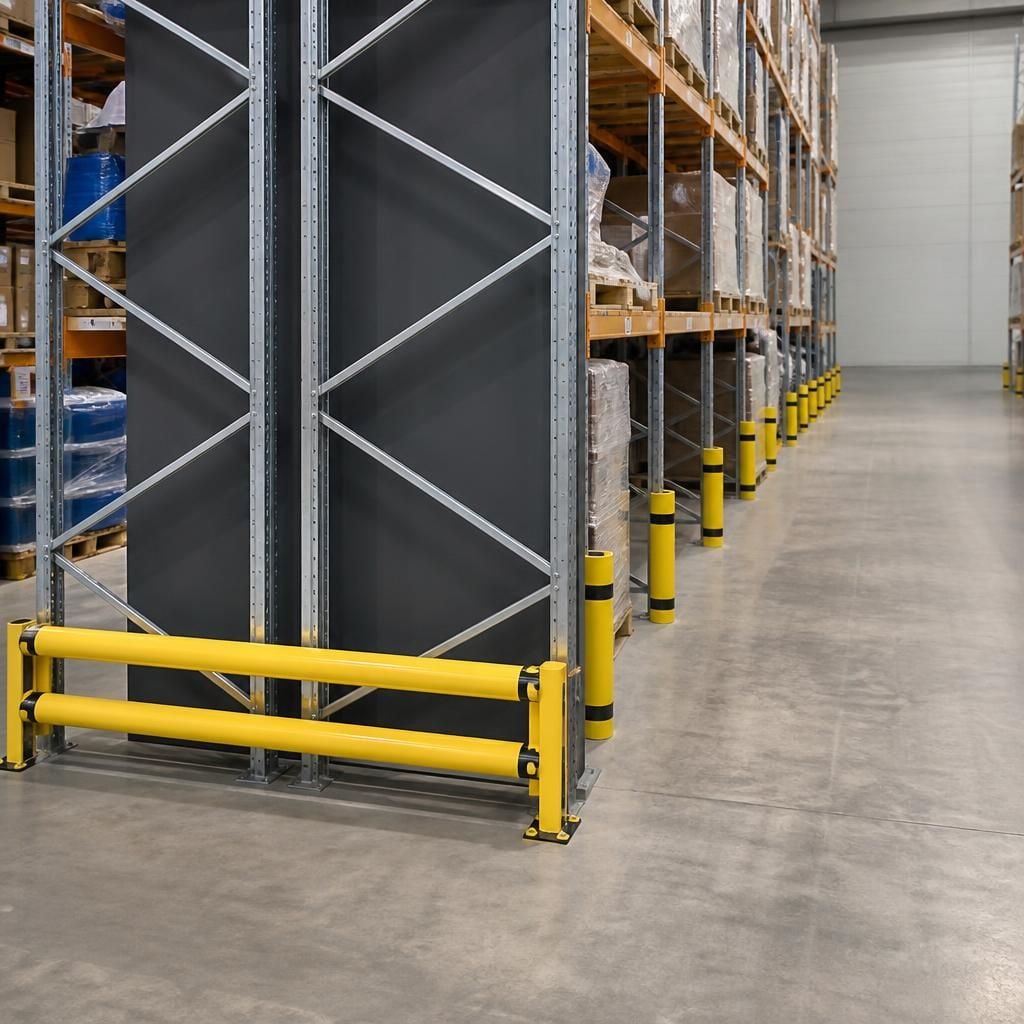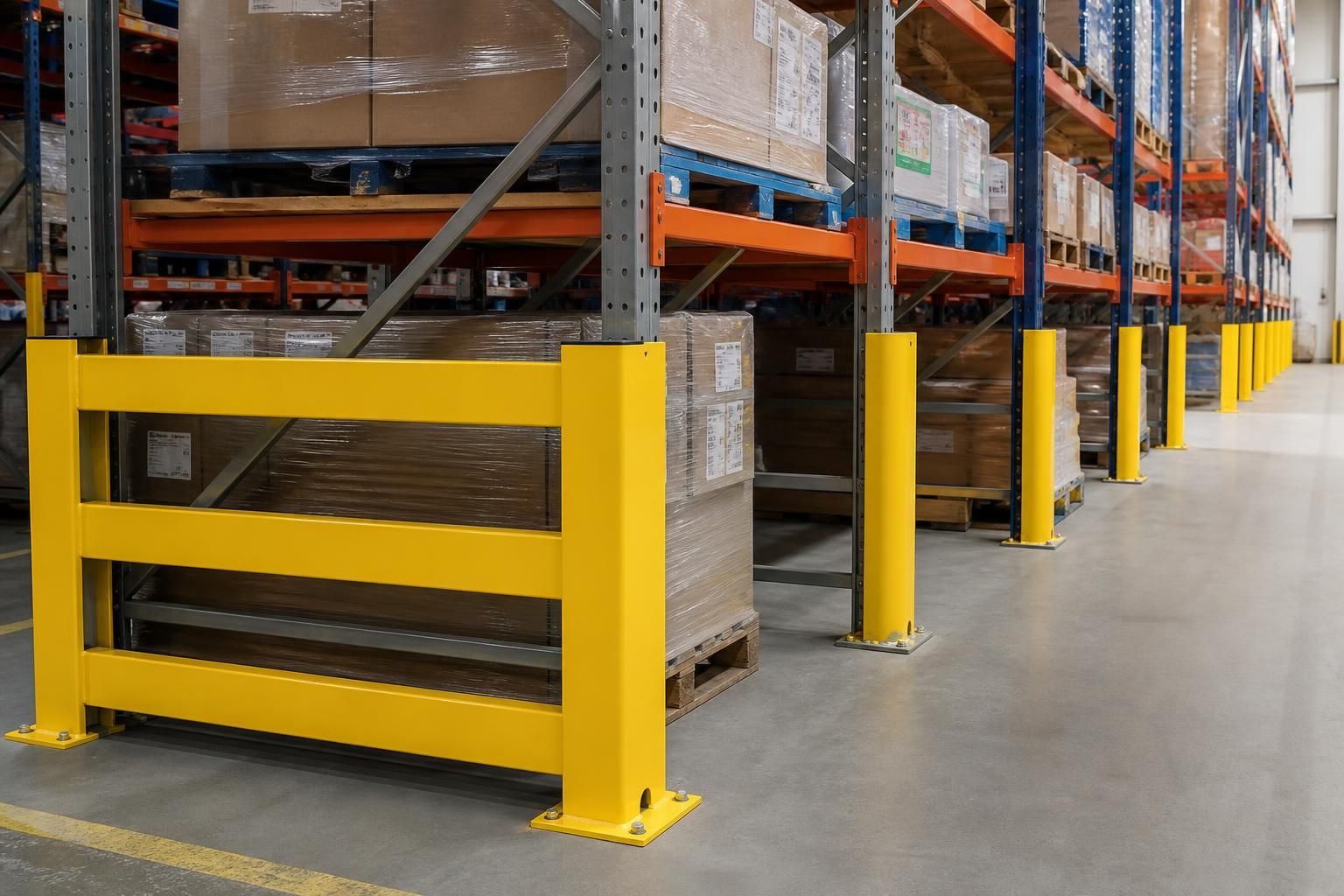
When should you choose pallet rack end guards over individual column guards?
Choose pallet rack end guards when an exposed rack end faces vehicle traffic and needs continuous protection across the frame.
Choose individual column guards when impact risk is limited to specific uprights and broader end protection is unnecessary.
The choice turns on the shape of the impact zone. Use pallet rack end guards for a defined rack-end exposure. Use individual column guards when contact risk is confined to particular uprights within the layout.
Choose pallet rack end guards when:
- Forklift or pallet truck movements approach the end of a racking run.
- Vehicles turn near the rack end and could approach from more than one direction.
- Several uprights sit within the same likely impact area.
- The rack end borders a cross-aisle, loading route or other vehicle movement area.
- You want one coordinated protection zone rather than separate guards around each exposed upright.
This arrangement suits layouts where the rack end creates a clear point of exposure. It also gives the protection plan a visible boundary between the racking and vehicle routes.
Choose individual column guards when:
- Only specific uprights sit beside vehicle or handling routes.
- The remaining rack structure has no comparable impact exposure.
- Fixed equipment, walls or the building layout already restrict vehicle movement.
- A separate guard around the rack end would protect areas that do not need it.
- The risk assessment identifies isolated contact points rather than one continuous end-zone risk.
Individual column guards can therefore suit a more localised protection plan. The guard position should still allow safe access for pallet handling, stock movement and inspections.
Assess the vehicle approach first. Mark forklift routes, turning movements and stopping points around the racking. Include pedestrian paths and any areas where vehicles reverse or manoeuvre.
Then identify which uprights could receive contact. A rack end may face direct approach, angled movement or traffic from adjoining aisles. Those movements may expose more than one column, even when the initial contact point appears narrow.
Check clearance around the proposed protection. The guard must not create a new obstruction for pallets, handling equipment or pedestrians. Review the usable aisle width and the position of stock at the lowest storage levels.
Also consider how the guard interacts with the building and other workplace safety measures. Barrier protection, segregation, line marking and safety signs may form part of the wider layout review.
Compare the protection area, not only the item price. For end guards, consider the length and number of rack positions covered. For column guards, count the uprights needing protection and check whether other exposed points remain.
A lower number of individual guards does not automatically mean the layout has adequate protection. Equally, an end guard may cover areas that present no meaningful impact risk. The correct comparison reflects the traffic pattern, rack arrangement and handling activity.
Consider future changes before fixing the choice. New aisles, altered picking routes or changed storage positions can move the impact risk. Where the layout may change, record which uprights and routes led to the original selection.
That information makes a later review more straightforward. It also helps you assess whether protection remains suitable after changes to stock, equipment or workflow.
Use a site survey where the boundary is unclear. Our consultation may include a site meeting and survey, followed by a written proposal and working drawings. These documents can show the protection arrangement against the racking and traffic routes.
We can also coordinate installation and project management where the work forms part of a wider warehouse layout project. This approach helps you compare end guards and column guards against the actual space, access requirements and identified impact points.
In summary: select pallet rack end guards when the rack end presents a shared vehicle hazard. Select individual column guards when the risk is limited to defined uprights. Base the decision on movement, clearance and the full protection area.
The choice does not have to be uniform across the warehouse. Use pallet rack end guards at exposed run ends, then individual column guards at isolated uprights elsewhere.
This combined approach matches protection to each movement pattern. It avoids extending end protection into areas with different risks while covering separate contact points.
Record where each protection type starts and finishes on the layout drawings. This makes the intended arrangement clearer at corners, aisle transitions and adjoining vehicle routes.