Warehouses rarely have identical storage requirements, which is why there are several types of pallet racking systems available. The right choice depends on factors such as available space, pallet weight, stock rotation and how goods are handled within the warehouse.
Understanding the different pallet racking systems helps businesses maximise storage capacity, improve operational efficiency and ensure safe access to goods. From high-throughput distribution centres to compact storage environments, selecting the correct system plays a key role in long-term warehouse performance.
At Spartan Direct, we supply a wide range of industrial pallet racking solutions designed to suit UK warehouses of all sizes, layouts and operating demands.
Ready to Explore Your Options?
Depending on your storage requirements, Spartan Direct offers a range of pallet racking systems including double deep pallet racking, wide aisle pallet racking, drive-in pallet racking, narrow aisle pallet racking, push back pallet racking, mobile pallet racking, pallet live racking, and heavy duty pallet racking.
Contact Spartan Direct today for a free consultation and no-obligation quote.
Enquire Now
10 Common Questions About The Types of Pallet Racking Systems
What are the main types of pallet racking systems?
The main types of pallet racking systems used in UK warehouses include selective pallet racking, double deep pallet racking, drive-in pallet racking, narrow aisle pallet racking, push back pallet racking, pallet live racking, mobile pallet racking, and heavy duty pallet racking.
Each system balances accessibility, storage density and workflow efficiency in different ways.
What is selective pallet racking?
Selective pallet racking is the most widely used warehouse racking system. It provides direct access to every pallet, making it ideal for warehouses that handle a wide range of products and frequent stock movement.
It is flexible, cost-effective and easy to reconfigure as storage requirements change.
What is double deep pallet racking?
Double deep pallet racking stores pallets two deep instead of one, reducing the number of aisles required and increasing storage density.
It works best where multiple pallets of the same product are stored together and where specialist forklifts can reach deeper loads.
What is drive-in pallet racking?
Drive-in pallet racking is a high-density storage system where forklifts drive directly into the racking structure to load and retrieve pallets.
It operates on a last-in-first-out basis and is commonly used for large volumes of identical products.
What is narrow aisle pallet racking?
Narrow aisle pallet racking reduces aisle widths to maximise storage capacity while maintaining direct pallet access.
It requires specialist narrow aisle or articulated forklifts but allows more pallets to be stored within the same warehouse footprint.
What is push back pallet racking?
Push back pallet racking uses a series of wheeled carts that allow pallets to be stored several deep.
Each new pallet pushes the previous pallet backwards, creating a last-in-first-out system that offers high density without forklifts entering the racking.
.
What is pallet live racking?
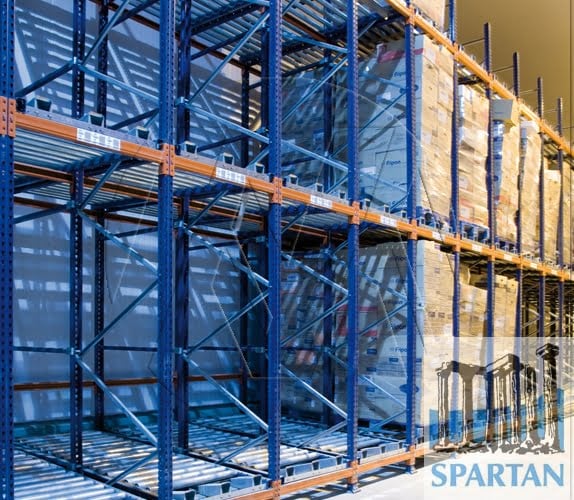
Pallet live racking uses gravity-fed rollers to move pallets from the loading side to the picking side. This creates a first-in-first-out system, making it suitable for time-sensitive products such as food, drink and pharmaceuticals.
What is mobile pallet racking?
Mobile pallet racking is mounted on movable bases that run on floor tracks. Aisles open only when access is required, allowing warehouses to achieve extremely high storage density.
This system is often used in cold stores and environments where space is limited.
What is heavy duty pallet racking?
Heavy duty pallet racking is designed for particularly heavy or dense loads.
It uses reinforced steel components and is commonly installed in manufacturing and industrial environments where standard pallet racking may not provide sufficient load capacity.
How do you choose the right pallet racking system?
Choosing the right system depends on your warehouse layout, pallet sizes, load weights, stock rotation, forklift type and future growth plans.
Comparing different pallet racking systems and carrying out a professional site survey helps ensure the system supports both current operations and long-term scalability.