Aisle width plays a critical role in warehouse efficiency, safety and storage capacity.
The distance between racking rows affects how forklifts operate, how quickly goods can be moved, and how much storage can be achieved within the available space.
Planning aisle widths correctly helps businesses strike the right balance between accessibility and storage density.
Understanding how warehouse racking layout decisions impact workflow is essential when designing or upgrading a pallet racking system.
At Spartan Direct, we support businesses with warehouse racking systems designed around their handling equipment, stock profile and operational requirements.
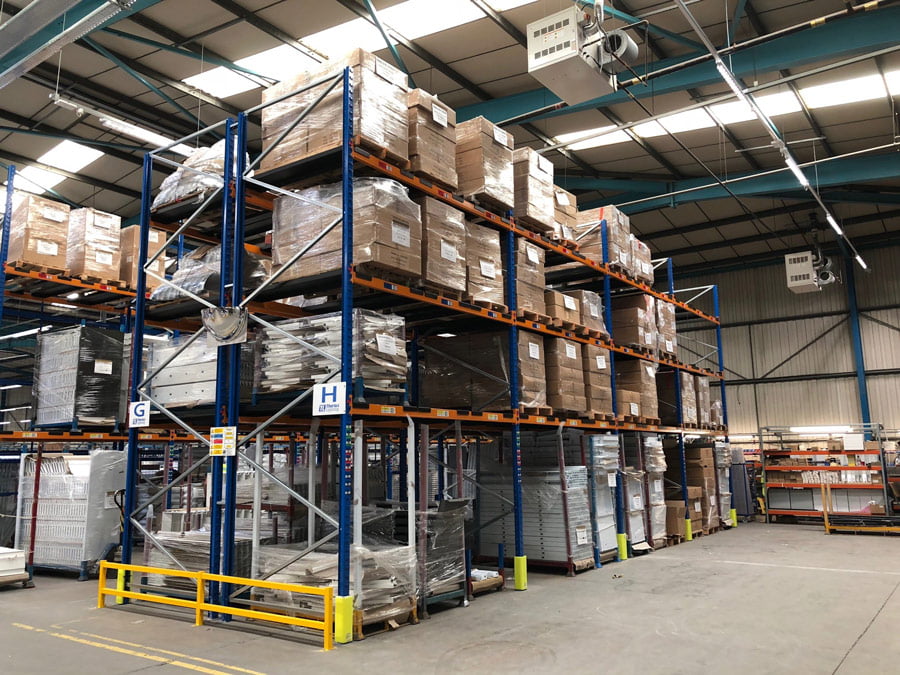
Designing an Efficient Warehouse Layout
Warehouse layout planning is about more than maximising pallet positions.
While wide aisle pallet racking offers flexibility and ease of access, narrow aisle pallet racking can significantly increase capacity where space is limited.
Spartan Direct designs warehouse racking systems that balance aisle widths, handling equipment, and storage requirements.
Our team can help assess your space and recommend a layout that supports efficiency, safety, and future growth.
Contact Spartan Direct today for a free consultation and no-obligation quote.
Enquire Now
10 Common Questions About High-Density Pallet Racking Systems
What is wide aisle pallet racking?
Wide aisle pallet racking uses larger aisle widths to accommodate standard counterbalance forklifts.
It provides excellent access to pallets and is suitable for warehouses that prioritise ease of movement and flexibility.
What is narrow aisle pallet racking?
Narrow aisle pallet racking reduces aisle width to increase storage capacity.
It requires specialist narrow aisle or articulated forklifts but allows more pallets to be stored within the same warehouse footprint.
How wide should warehouse aisles be?
Aisle width depends on the type of forklift used, pallet size and load handling method.
Counterbalance forklifts require wider aisles, while reach trucks and narrow aisle trucks operate safely in reduced widths.
How do aisle widths affect storage capacity?
Wider aisles reduce overall pallet positions but improve accessibility.
Narrower aisles increase storage density but may require investment in specialist handling equipment. The right balance depends on operational priorities.
What forklifts are used in narrow aisle warehouses?
Narrow aisle warehouses typically use very narrow aisle trucks, articulated forklifts or turret trucks. These machines are designed to operate safely within tight spaces and reach greater racking heights.
Is narrow aisle racking more expensive?
While narrow aisle pallet racking can increase storage capacity, it may involve higher upfront costs due to specialist forklifts and guidance systems.
However, the improved space utilisation can deliver long-term cost savings.
How do you plan a warehouse racking layout?
Planning a layout involves assessing floor space, ceiling height, load weights, pallet sizes, forklift turning circles and future growth. A professional survey ensures the warehouse racking layout supports safe and efficient operations.
Can aisle widths be changed later?
In many cases, aisle widths can be adjusted by reconfiguring racking layouts. However, changes may affect forklift suitability and overall capacity, so future expansion should be considered during initial design.
How does layout impact picking efficiency?
A well-planned layout reduces travel time, improves stock visibility, and supports smoother picking routes. Correct aisle planning helps minimise congestion and improve daily warehouse productivity.
How do aisle widths affect warehouse safety?
Adequate aisle widths reduce collision risk, improve visibility and allow safe forklift operation. Proper aisle planning is a key part of designing compliant and safe warehouse racking systems.